
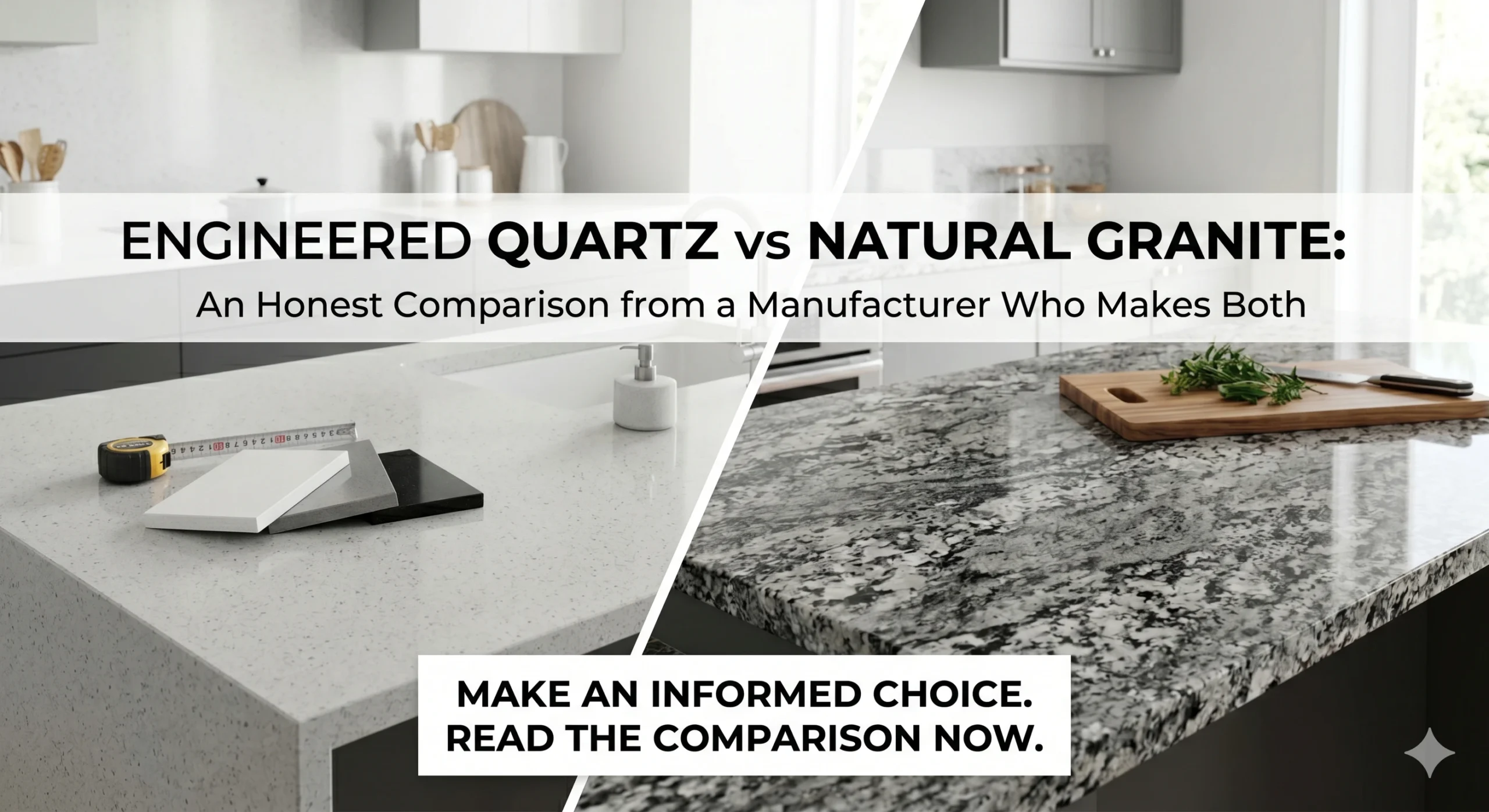
Most articles comparing quartz and granite are written by retailers who sell only one of the two, which means the comparison is never quite honest. Either quartz is presented as the flawless modern solution, or granite is positioned as the only “real” stone worth having.
We’re in a different position. At Universal Granimarmo, we manufacture both. Our quarries and factories produce natural granite slabs, and our Universal Quartz division produces engineered quartz surfaces. We have no commercial reason to push you toward one over the other — our job is to help you pick the right material for your actual kitchen, your actual budget, and your actual lifestyle.
This is that honest comparison.
What Each Material Actually Is
Natural Granite
Granite is 100% natural igneous rock, formed over millions of years deep within the earth’s crust and quarried directly from bedrock. Each slab is cut, polished, and finished from a single block of stone — meaning every slab has a pattern that exists nowhere else on earth.
At UGM, our granite comes from our own quarries and factories in Rajasthan (Jalore, Ajitgarh) and South India (Ongole, Karimnagar). What you buy is exactly what nature made — we cut, polish, and finish it, but we don’t alter its composition.
Engineered Quartz
Engineered quartz is a manufactured surface, typically composed of approximately 90–93% crushed natural quartz crystals mixed with polymer resins and pigments. The quartz mineral itself is natural and is one of the hardest minerals on earth, but the slab you buy is an engineered composite, manufactured under controlled factory conditions rather than quarried whole.
This composition is what gives engineered quartz its key advantage: it is dense, nonporous, and engineered for consistency in a way natural stone cannot be.
Important clarification we give every customer: Engineered quartz is not the same as a “quartzite” — quartzite is a separate, 100% natural metamorphic stone. Engineered quartz contains quartz as an ingredient; it is not a solid block of quartz.
Appearance: Natural Variation vs Engineered Consistency
This is the most fundamental difference between the two materials, and it should be the starting point of your decision.
Granite offers a unique, one-of-a-kind pattern in every slab — no two pieces are ever alike. A Black Galaxy slab from our Ongole facility will have its own unique distribution of gold flecks. A Fantasy Brown slab will have its own unique veining pattern. This natural variation is exactly what many buyers want — proof that their countertop is genuinely one-of-a-kind.
Engineered quartz is precision-manufactured, so you choose an exact tone or pattern and receive a consistent result across your surfaces. This makes it significantly easier to match multiple slabs across a large kitchen island, multiple bathrooms, or a commercial project where dozens of units need to look identical.
Our honest take: If you’re buying one slab for one kitchen and want a unique, conversation-starting surface, granite wins easily. If you’re fitting out a 200-unit apartment development and every kitchen needs to look exactly the same, quartz is the only realistic choice.
Durability: A More Nuanced Comparison Than You’ve Been Told
Most comparison articles say “quartz is more durable” and leave it there. As manufacturers of both, we think that’s an oversimplification.
Scratch and Chip Resistance
Quartz’s engineered composition creates consistent strength throughout the material without natural weak points — meaning quartz generally resists scratching and chipping slightly better than granite, especially at edges and corners. This is a genuine advantage for high-traffic kitchens, rental properties, or commercial use.
However, granite is exceptionally hard in its own right — particularly our South Indian varieties like Absolute Black and Black Galaxy, which have very high compressive strength. In normal residential use, both materials perform well; quartz’s edge is most noticeable at vulnerable points like sink cutouts and counter edges over many years of use.
Heat Resistance — Granite’s Clear Advantage
This is where the comparison tips firmly toward granite. Granite offers excellent heat resistance and can handle a hot pan placed directly on the surface without damage. Quartz, because of its resin content, is genuinely vulnerable to heat — direct contact with hot pots, pans, or trivets left too long can cause discolouration or even cracking in the resin binder.
Our honest take: If you cook frequently and tend to set hot cookware directly on the counter without a trivet, granite is the safer long-term choice. We tell every customer who mentions heavy daily cooking to seriously weigh this factor.
Staining and Porosity
Granite is naturally porous and must be sealed periodically to prevent staining, while quartz is non-porous and never needs sealing — spilled wine, oil, or acidic liquids simply sit on the surface without penetrating it.
This is the area where quartz has the most genuine, unambiguous advantage. South Indian granites we manufacture (Black Galaxy, Absolute Black) have extremely low porosity already, but quartz’s non-porous nature removes the sealing requirement entirely.
Long-Term Lifespan
Both materials, properly cared for, last for decades. Granite resealing typically needs to happen every 1–5 years, depending on the variety and usage, a small recurring task most homeowners manage easily. Quartz requires essentially no maintenance tasks at all beyond normal cleaning.
Maintenance: The Real Day-to-Day Difference
This is usually the deciding factor for most buyers, so let’s be specific.
Granite Maintenance
- Sealing: Required periodically — typically every 1 to 5 years, depending on variety, with low-porosity varieties like Black Galaxy and Absolute Black needing it less often than lighter, more porous stones
- Daily cleaning: Mild soap and water; avoid harsh acidic cleaners on unsealed areas
- Hot pans: Safe to place directly on the surface
- Cutting directly on the surface: Technically possible due to hardness, though we always recommend a cutting board to preserve the polish
Engineered Quartz Maintenance
- Sealing: Never required — the resin makes the surface permanently non-porous
- Daily cleaning: Soap and water; a quick wipe-down handles virtually any spill, including wine, oil, and acidic foods
- Hot pans: Trivets and hot pads strongly recommended — direct heat exposure risks resin damage
- Cutting directly on the surface: Not recommended; the resin layer can be marked by direct blade contact
Our honest take: Quartz genuinely is the lower-maintenance material. If your priority is the absolute minimum ongoing care — particularly for buy-to-let properties, busy family kitchens, or commercial installations — quartz wins this category outright.
Cost Comparison: 2026 Pricing
Pricing varies by market and grade, but the general pattern globally holds steady:
Quartz countertops typically cost more upfront for premium designer ranges, while granite remains highly competitive — particularly when sourced directly from Indian manufacturers rather than through multiple distribution layers.
| Factor | Natural Granite | Engineered Quartz |
| Material cost (FOB India, per sqm) | USD 12–55 depending on variety | USD 25–60 depending on design |
| Long-term maintenance cost | Low — periodic resealing | Essentially none |
| Price consistency | Varies by quarry, rarity, batch | More predictable, factory-controlled |
| Premium tier pricing | Tan Brown and Steel Grey offer excellent value | Designer marble-look and bold-pattern ranges command top prices |
| Value-tier pricing | Tan Brown, Steel Grey offer excellent value | Standard solid-colour ranges are most affordable |
Our honest take on value: When you factor in granite’s occasional resealing cost against quartz’s typically higher upfront price, the lifetime cost of both materials often ends up closer than buyers expect. Direct-from-manufacturer granite, like what we supply at UGM, frequently offers the best value of all — because it removes the import and distributor markup that inflates quartz pricing in many markets.
Design and Style: Which Fits Your Kitchen?
Both materials are excellent design choices, but they suit different aesthetic philosophies.
Choose Granite If You Want:
- A genuinely natural, one-of-a-kind surface with organic movement
- Dramatic mineral patterning — gold flecks, deep veining, bold colour shifts
- A timeless material with proven multi-decade performance history
- The authenticity of real stone, with each slab telling its own geological story
Choose Engineered Quartz If You Want:
- Perfect colour and pattern consistency across a large kitchen or multiple rooms
- The widest possible range of colour options, including shades that don’t naturally occur in stone
- A surface engineered specifically to resist staining without any sealing routine
- A sleek, contemporary, uniform aesthetic
The 2026 Design Trend Reality
2026 is seeing renewed interest in dramatic granites featuring bold colours, exotic patterns, and striking veining — particularly for statement kitchen islands. At the same time, both materials now offer honed and matte finishes that provide a sophisticated, contemporary look while hiding fingerprints and water spots better than high-gloss polished surfaces.
In other words, the “natural vs engineered” choice in 2026 is less about which one is more fashionable, and more about which finish and colour story fits your specific kitchen.
Where Quartz Genuinely Wins
We make both products, so we’ll say this plainly:
- Zero sealing maintenance — a real, lasting convenience advantage
- Stain resistance without upkeep — particularly valuable for households with young children or very active kitchens
- Colour and pattern uniformity — essential for large commercial projects, hotel chains, and multi-unit residential developments
- Predictable batch matching — every slab from the same production run looks identical
Where Natural Granite Genuinely Wins
And we’ll say this just as plainly:
- Unmatched heat resistance — a meaningful advantage for serious home cooks
- Authentic, one-of-a-kind natural beauty — no engineered material fully replicates the depth of real mineral movement, especially in premium varieties like Black Galaxy or Fantasy Brown
- Generally lower cost when sourced directly from manufacturers — particularly relevant for buyers importing in bulk from India
- No resin to degrade over decades — natural stone has no synthetic binder that can yellow, weaken, or react to UV exposure over very long timeframes (a consideration for granite used outdoors, where quartz is rarely recommended at all)
An important point most quartz retailers won’t tell you: Engineered quartz is generally not recommended for outdoor use, because UV exposure can cause the resin to fade or degrade over time. Natural granite has no such limitation — it is the standard material for outdoor kitchens, exterior cladding, and sun-exposed countertops worldwide.
Our Recommendation Framework
After manufacturing both materials for years and fielding this exact question from buyers across the UAE, USA, and Europe, here is the honest framework we give every customer:
| If you… | We recommend… |
| Cook frequently and place hot pans directly on the counter | Granite |
| Want a completely low-maintenance surface with zero sealing | Quartz |
| Are fitting out multiple identical units (hotel, apartment development) | Quartz |
| Want a one-of-a-kind, conversation-starting natural surface | Granite |
| We are working with a tighter direct-import budget | Granite |
| Have young children and prioritise stain-proofing over character | Quartz |
| Are you installing an outdoor kitchen or a sun-exposed surface | Granite (often better value when sourced from the manufacturer) |
| Want the widest possible colour range, including non-natural tones | Granite (often a better value when sourced from the manufacturer) |
Frequently Asked Questions
Q: Is engineered quartz more expensive than natural granite?
It depends on the tier. Premium designer quartz ranges are often more expensive than mid-range granite. However, premium granite varieties like Black Galaxy can cost as much or more than standard quartz. When sourced directly from an Indian manufacturer, granite frequently offers better value at every tier.
Q: Can engineered quartz crack from heat the way granite resists it?
Yes — this is one of quartz’s genuine weaknesses. The resin binder in engineered quartz can discolour or crack under direct, sustained heat exposure, whereas natural granite handles direct contact with hot pans without damage.
Q: Does granite really need to be sealed every year?
Not necessarily. Sealing frequency depends on the variety. Low-porosity South Indian granites like Black Galaxy and Absolute Black may only need resealing every 3–5 years. Lighter, more porous varieties benefit from more frequent sealing, typically annually in heavy-use kitchens.
Q: Which material is better for outdoor kitchens?
Granite, without question. Engineered quartz’s resin content makes it vulnerable to UV degradation outdoors, while granite is the global standard material for outdoor kitchens, facades, and sun-exposed surfaces.
Q: Can UGM supply both quartz and granite for the same project?
Yes. As a manufacturer of both, UGM regularly supplies mixed-material orders — for example, granite for an outdoor kitchen and quartz for the indoor kitchen of the same project — under a single consolidated order and documentation set.
Q: Which material has better resale value for a home?
Both are considered premium countertop materials and are viewed positively by buyers and appraisers. Granite’s perception as “natural luxury stone” still carries strong appeal in many markets, particularly the Gulf and parts of Europe, while quartz’s low-maintenance reputation appeals strongly to buyers in the USA and UK.
Conclusion
There is no universally “better” material between engineered quartz and natural granite — only the better choice for your specific kitchen, climate, cooking habits, and design taste.
As a manufacturer of both, our honest advice is this: if you love the idea of a surface that is genuinely one-of-a-kind, performs exceptionally under heat, and offers outstanding value when sourced directly from the source — choose granite. If your priority is the lowest possible maintenance routine and perfect colour consistency across a large project, choose quartz.
At Universal Granimarmo, we manufacture premium natural granite from our facilities in Rajasthan and South India, and engineered quartz surfaces under our Universal Quartz division — giving buyers in the UAE, USA, Europe, Oman, and Qatar a single trusted source for both materials. Need help deciding for your specific project? Contact our team for honest, no-pressure advice and a sample request for either material.