
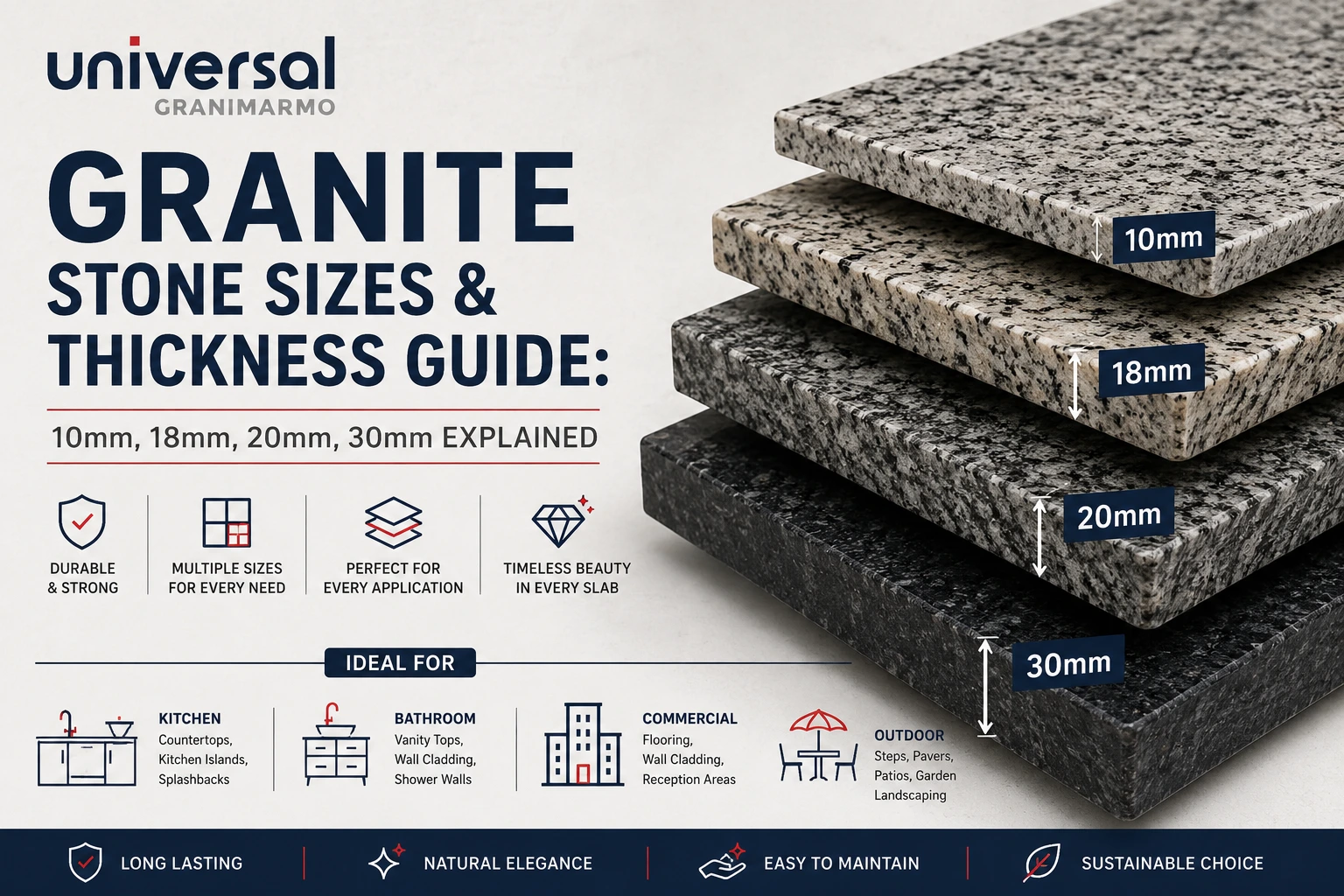
One of the most common sources of confusion in any granite procurement — whether you’re a first-time buyer, a seasoned architect, or an international importer — is the question of size and thickness. What does 30mm actually mean in practice? Is 18mm enough for commercial flooring? Why does wall cladding use 10mm when countertops use 30mm?
These questions matter enormously. Specifying the wrong thickness leads to cracked tiles, failed installations, voided warranties, and costly rework. Specifying the wrong size leads to excessive waste, unnecessary seams, and mismatched visual results on site.
At Universal Granimarmo, we manufacture and export granite tiles and slabs across the full size and thickness range — from 10mm decorative wall panels to 40mm custom kerbstones — from our production facilities in Rajasthan and South India. Every day, our team answers these specification questions for architects, contractors, and importers across the UAE, Europe, the USA, and beyond.
This is our complete, no-confusion guide to granite sizes and thickness — with every number explained, every application mapped, and a full reference table you can use directly in your project specification.
Why Granite Size and Thickness Matter
Before diving into the numbers, let’s be clear about what’s at stake:
Structural performance: Granite’s ability to bear load, resist cracking, and survive impact is directly proportional to its thickness. A 10mm slab on a kitchen countertop will crack. A 30mm tile on a lightweight wall substrate creates unnecessary load risk. Matching thickness to application is a structural requirement, not a preference.
Weight management: Granite is heavy. A single large-format tile can weigh upwards of 100 pounds, necessitating careful handling and installation techniques. Thicker stone on walls means more load on anchors, substrates, and structural elements below. Getting weight right from the start avoids expensive structural remediation later.
Aesthetics: The thickness of the stone influences its visual prominence. A thicker edge creates a bold, high-end look, whereas a thinner slab appears sleek and modern.
Cost efficiency: Standard sizes permit factories to cut several tiles out of the same slab, with minimal waste. Standard-size tiles such as 60×60 cm or 60×120 cm can be cut from a 240×120 cm slab with minimum waste compared to cutting to some arbitrary size. Specifying non-standard sizes drives up cost significantly.
Understanding Granite Formats — Tiles vs Slabs
Before discussing specific dimensions, it’s important to understand the two main commercial formats of granite:
Granite Tiles
Tiles are pre-cut pieces in standardised dimensions — typically square or rectangular, cut from larger slabs. They are the most common format for flooring, wall cladding, and bathrooms.
Tiles offer:
- Predictable, consistent sizing for easy installation planning
- Lower per-piece cost than slabs
- Simpler logistics — more pieces per container
- Standard grout joint installation
Granite Slabs
Slabs are large, uncut pieces of granite in their full quarried and polished dimensions. They are used for countertops, large feature walls, and bespoke applications where minimal seams are required.
Standard stone slab size is usually expressed as a typical range because quarry output varies, but many stone slabs commonly fall around 108–120 inches long × 60–72 inches wide (274–304 cm × 152–182 cm).
Slabs offer:
- Minimal seams across large surfaces
- More dramatic, uninterrupted visual impact
- Flexibility for custom cutting and edge profiling
- Required for countertop fabrication
UGM supplies both formats — standard tile sizes cut to specification, and full polished slabs for countertop and bespoke applications — from all our production facilities.
Standard Granite Tile Sizes — The Complete Reference
Granite tile sizes are standardised across the global industry to maximise yield from quarried slabs and minimise installation waste. Here are all commercially significant tile sizes, with their applications:
Small Format Tiles (Under 40×40 cm)
| Size | Typical Use |
| 30×30 cm (12″×12″) | Bathroom floors, small utility areas, and traditional flooring patterns |
| 30×60 cm (12″×24″) | Bathroom walls, feature wall accents, and narrow corridor flooring |
| 40×40 cm (16″×16″) | Residential flooring, outdoor paving, traditional layouts |
Small-format tiles are the most economical option and easiest to handle on-site. They are particularly useful for curved areas, irregular spaces, and heritage-style flooring patterns where a mosaic or varied joint layout is desired.
Mid Format Tiles (40–60 cm)
| Size | Typical Use |
| 60×30 cm (24″×12″) | Bathroom flooring, kitchen backsplash, wall cladding |
| 60×40 cm (24″×16″) | Outdoor paving, garden paths, terrace tiles |
| 60×60 cm (24″×24″) | The global standard — residential and commercial flooring, wall cladding |
The 60×60 cm tile is the single most widely specified granite tile size in the world. It balances visual impact, ease of handling, installation speed, and material efficiency. For any project where you’re unsure of the tile size to specify, 60×60 cm is the professional default.
Large Format Tiles (60–120 cm)
| Size | Typical Use |
| 60×90 cm (24″×36″) | Commercial flooring, hotel lobbies, large residential open plans |
| 60×120 cm (24″×48″) | Premium commercial flooring, feature walls, contemporary interiors |
| 90×90 cm (36″×36″) | Luxury residential flooring, high-design commercial spaces |
| 120×60 cm (48″×24″) | Large-area flooring, exterior paving, facade panels |
Large format tiles create fewer grout lines, a more seamless visual appearance, and a strong sense of luxury and scale. Large format tiles typically measure 24 inches by 48 inches or larger, allowing for fewer grout lines and a more seamless appearance. This not only enhances the visual appeal of spaces but also simplifies maintenance, as there are fewer joints where dirt and grime can accumulate.
The trade-off: larger tiles are heavier and require flatter, more precisely prepared substrates. On walls, they require proper mechanical anchoring systems rather than adhesive-only fixing.
Jumbo / Statement Format Tiles
| Size | Typical Use |
| 120×120 cm (48″×48″) | Statement floors, luxury hotel lobbies, premium commercial |
| 240×60 cm (96″×24″) | Plank-style flooring, corridor applications |
| Custom sizes | Project-specific cuts for landmark and bespoke installations |
UGM supplies jumbo format tiles and custom-cut pieces for landmark projects — including facade panels for exterior cladding on commercial buildings, where large uninterrupted stone panels create the most architectural impact.
Standard Granite Slab Sizes
Full slabs are the starting material from which both tiles and countertops are fabricated. Understanding slab dimensions helps you plan yield, minimise waste, and avoid unnecessary seams.
Gangsaw Slabs (Full-Size)
Gangsaw slabs are the largest commercially available format — cut directly from quarry blocks using multi-blade gang saws.
| Slab Type | Typical Dimensions | Notes |
| Standard Gangsaw | 240×120 cm (8’×4′) | Most common export format from India |
| Large Gangsaw | 260×160 cm (8.5’×5.3′) | Premium format; wider quarry blocks |
| Extra Large | 300×180 cm+ | Specialty format; limited availability by variety |
Standard stone slab thickness is typically 2 cm (20mm) or 3 cm (30mm), with 1.5 cm (15mm) sometimes supplied for vertical panels and lighter applications.
UGM gangsaw slabs are available in 240×120 cm and 260×160 cm formats in most granite varieties. For Black Galaxy — quarried at our Ongole facility — larger format slabs are available, subject to quarry block yield.
Cutter Slabs (Half-Size)
Cutter slabs are smaller pieces cut from gangsaw slabs, typically used when the full slab size is not required or when quarry block yield does not produce a full-size slab.
| Cutter Slab Type | Typical Dimensions |
| Standard cutter | 120×60 cm (4’×2′) |
| Half slab | 140×70 cm (4.6’×2.3′) |
Cutter slabs are priced lower per piece than full gangsaw slabs, but higher per sqm — because they produce more waste in fabrication. For large countertop projects, always specify full gangsaw slabs.
Granite Thickness — Every Measurement Explained
This is the section most buyers need the most. Here is every commercially significant granite thickness, what it means structurally and visually, and exactly where it belongs.
10mm — Decorative and Lightweight Applications
What it is: The thinnest standard commercial granite thickness. At 10mm, granite is light but requires careful handling and additional support.
Structural capacity: Not self-supporting. Must be adhered to a substrate (plywood, cement board, or mesh backing) for structural integrity.
Weight: Approximately 26–28 kg per sqm (depending on stone density). The lightest granite option — critical for high-rise wall cladding where total load is a design constraint.
Best applications:
- Interior decorative wall panels and feature walls
- Kitchen and bathroom backsplashes
- Elevator interior cladding
- Furniture tops and decorative inserts
- Lightweight facade veneer panels (with proper backing)
Avoid for: Any horizontal surface bearing load, flooring, or exterior exposure without specialist backing systems.
UGM note: We supply 10mm panels primarily for interior wall cladding and decorative applications, typically in polished or honed finish. Mesh-backed options available on request for lightweight facade systems.
12mm — Standard Wall Tile
What it is: One step above 10mm — marginally more robust, suitable for a wider range of wall applications without additional backing.
Structural capacity: Suitable for wall cladding with standard adhesive fixing. Still requires a flat, well-prepared substrate.
Weight: Approximately 31–33 kg per sqm.
Best applications:
- Bathroom wall tiles
- Interior wall cladding in standard sizes (up to 60×60 cm)
- Restroom vanity surrounds
- Low-traffic decorative flooring in dry residential areas
Avoid for: Countertops, exterior applications, commercial flooring, or large-format tiles over 60×60 cm without mechanical anchoring.
16mm — Residential Flooring Entry Point
What it is: The minimum recommended thickness for standard residential flooring. Provides adequate strength for normal domestic foot traffic when installed on a properly prepared substrate.
Structural capacity: Self-supporting in standard tile sizes up to 60×60 cm on a flat concrete or screed substrate. Not recommended for commercial traffic.
Weight: Approximately 42–44 kg per sqm.
Best applications:
- Residential flooring in bedrooms, living areas, and corridors
- Stair risers (vertical face panels)
- Low-traffic bathroom floors
- Light exterior paving in residential settings
Avoid for: Commercial flooring, heavy-traffic areas, stair treads, or any application where substrate flatness cannot be guaranteed.
18mm — The Residential Standard
What it is: The most widely used thickness for residential granite flooring worldwide. Granite floor tiles in homes are often around 16mm to 18mm thick — sturdy enough for normal foot traffic while keeping material costs manageable.
Structural capacity: Robust for all residential applications. Handles standard domestic foot traffic, furniture load, and typical household impact reliably.
Weight: Approximately 47–49 kg per sqm.
Best applications:
- Residential flooring throughout: living rooms, bedrooms, kitchens, bathrooms
- Stair risers and light-duty stair treads in residential settings
- Interior wall cladding in larger formats (60×60 cm, 60×120 cm)
- Bathroom vanity tops (with substrate support)
- Outdoor terraces and patios in residential settings
Avoid for: Heavy commercial traffic, high-load stair treads in public buildings, or unsupported countertop overhangs.UGM note: 18mm is our most commonly ordered tile thickness across all markets. Available in all standard tile sizes from 30×30 cm through 60×120 cm. Polished, honed, flamed, and brushed finishes are all available at 18mm.
20mm (2cm) — The Commercial Standard
What it is: The step up from residential to commercial-grade specification. For high-traffic public areas or commercial buildings, thicker granite tiles or slabs are recommended — typically 18mm up to 20mm thick. A thicker tile can better withstand constant foot traffic, heavy objects, and wear over time.
Structural capacity: Handles commercial foot traffic, light trolley movement, and moderate concentrated loads. Self-supporting at standard commercial tile sizes.
Weight: Approximately 52–54 kg per sqm.
Best applications:
- Commercial interior flooring: offices, retail, restaurants, boutique hotels
- Bathroom countertops and vanity tops (self-supporting with minimal overhang)
- Stair treads in residential and light commercial settings
- Exterior paving in commercial landscaping
- Interior wall cladding in large format (90×90 cm, 120×60 cm) with mechanical anchoring
For countertops at 20mm: A plywood or MDF substrate backing is required for structural support. 20mm countertops are widely used in European residential projects and commercial fit-outs where weight management is a priority (e.g. high-rise buildings). They support standard edge profiles but have limited options for complex edge work.
Avoid for: High-traffic public flooring (airports, metro stations, malls), heavy-use kitchen countertops without substrate support, or unsupported overhangs exceeding 15cm.
30mm (3cm) — The Premium Standard
What it is: The professional standard for kitchen countertops and heavy-duty applications worldwide. Countertops typically require slabs that are at least 3cm thick for durability.
Structural capacity: Self-supporting. Can overhang up to 30cm without substrate backing. Handles all domestic and light commercial kitchen use without risk of cracking under normal conditions.
Weight: Approximately 78–81 kg per sqm — significantly heavier than 20mm. Structural and cabinet considerations must account for this in kitchen design.
Best applications:
- Kitchen countertops (the global professional standard — dominates USA, UAE, and Gulf markets)
- Bar tops and restaurant table surfaces
- Heavy commercial flooring: airports, metro stations, malls, hospital corridors
- Exterior facade cladding panels with mechanical anchoring
- Stair treads in public buildings and high-traffic commercial settings
- Large kitchen islands with waterfall edges
For countertops at 30mm: No substrate required. Supports the widest range of edge profiles — bullnose, ogee, waterfall, bevelled, dupont, and laminated profiles. The 30mm edge provides the visual weight and luxury presence that premium kitchen design demands.
If you want an especially thick, luxurious-looking counter, one option is to laminate the edge of a 2cm slab to give the illusion of a thicker edge — for example, creating a doubled 6cm apron front by bonding two slabs or adding a thick edge strip. UGM fabricates both solid 30mm slabs and laminated-edge countertops for export.
UGM note: 30mm is our most common countertop export thickness to UAE, Oman, Qatar, USA, and European buyers. Available in all major granite varieties, including Black Galaxy, Absolute Black, Kashmir White, Fantasy Brown, and Tan Brown.
40mm and Above — Heavy-Duty and Monumental
What it is: Beyond standard countertop and flooring specifications — into heavy civil, landscaping, and monumental applications.
Best applications:
- Kerbstones and road edge stones
- Exterior steps and heavy-duty stair treads in civic infrastructure
- Monumental installations and memorial stones
- Heavy-duty driveway paving
- Custom architectural elements and large-scale sculptures
UGM supplies custom 40mm+ pieces for civic and landscaping projects, primarily in Rajasthan granite varieties for kerbstone and step applications.
The Complete Application Reference Table
This is the definitive quick-reference guide — matching every application to its correct tile size and thickness:
| Application | Recommended Tile Size | Recommended Thickness | Finish |
| Residential interior flooring | 60×60 or 60×120 cm | 18mm | Polished or Honed |
| Commercial interior flooring | 60×60 or 60×120 cm | 20–30mm | Polished or Honed |
| Airport / transit hub flooring | 60×60 or 90×90 cm | 30mm | Honed or Brushed |
| Outdoor terrace / patio | 60×40 or 60×60 cm | 20mm | Flamed or Brushed |
| Pool surrounds | 60×30 or 60×40 cm | 20mm | Flamed or Bush Hammered |
| Driveway paving | 60×40 cm or custom | 30–40mm | Flamed |
| Kerbstones | Custom | 40mm+ | Flamed or Natural |
| Kitchen countertop | Full slab (240×120 cm) | 30mm | Polished or Leathered |
| Bathroom vanity/countertop | Full slab or cut-to-size | 20mm | Polished or Honed |
| Bar top | Full slab or cut-to-size | 30mm | Leathered or Polished |
| Kitchen backsplash | 30×30 or 30×60 cm | 10–12mm | Polished |
| Interior wall cladding | 60×30 to 60×120 cm | 12–18mm | Polished or Honed |
| Exterior facade cladding | 60×60 to 120×60 cm | 20–30mm | Flamed or Brushed |
| Feature/reception wall | 60×120 or custom | 18mm | Polished |
| Stair tread (residential) | Custom cut | 20mm | Honed |
| Stair tread (commercial/public) | Custom cut | 30mm | Honed or Flamed |
| Stair riser | Custom cut | 16–18mm | Polished or Honed |
| Elevator interior cladding | 60×30 or 60×60 cm | 10–12mm | Polished |
| Memorial/monument | Custom | 30–40mm | Polished |
Size Selection — Practical Rules for Any Project
Rule 1: Bigger is Not Always Better
Large format tiles look spectacular, but they demand flatter substrates, more skilled installation, and heavier structural support. For residential flooring where the substrate cannot be guaranteed perfectly flat, 60×60 cm is safer and more forgiving than 90×90 cm or 120×60 cm.
Rule 2: Match Thickness to Load — Always
Never underspecify thickness to save cost on a structural or high-traffic application. A cracked granite floor tile costs far more to replace than the saving made on specifying 16mm instead of 18mm. Use the reference table above as your starting point and go heavier when in doubt.
Rule 3: Standard Sizes Minimise Waste and Cost
Non-standard tile sizes (e.g., 55×55 cm, 45×90 cm) require the factory to cut from standard slabs — generating more offcut waste that you pay for. Specify standard dimensions wherever possible: 30×30, 60×60, 60×30, 60×120, 90×90 cm. Reserve custom sizes for feature elements, stair treads, and countertops where precision is architecturally required.
Rule 4: Add 10–15% Overage to Your Quantity
Natural stone has unavoidable cutting waste on site — particularly around doorframes, columns, and irregular walls. Always order 10% extra for straight-lay patterns and 15% for diagonal or herringbone patterns. For unique varieties (Black Galaxy, Crystal Yellow) where exact batch matching across re-orders is difficult, ordering 15–20% overage on the first order is strongly recommended.
Rule 5: Slab vs Tile — Know When to Use Each
Use slabs for countertops, large feature walls, and any application where minimising seams is architecturally important. Use tiles for flooring, wall cladding, bathrooms, and any application where a modular grid pattern is acceptable. Never use tiles for kitchen countertops — the number of joints creates hygiene, staining, and structural vulnerability issues that full slabs avoid entirely.
Frequently Asked Questions
Q: What is the standard granite thickness for kitchen countertops?
30mm (3cm) is the professional standard for kitchen countertops in the UAE, USA, and most global markets. It is self-supporting, allows the widest range of edge profiles, and provides the visual weight associated with premium kitchen design. 20mm with substrate backing is used in some European markets and commercial fit-outs where weight is a concern.
Q: What size granite tiles are most popular for flooring in 2026?
60×60 cm remains the global standard for residential and commercial flooring. 60×120 cm is growing strongly in commercial and premium residential applications where fewer grout lines and a more contemporary look are desired. For outdoor paving, 60×40 cm is widely specified.
Q: Can I use 18mm granite for a kitchen countertop?
Technically possible with full substrate support, but not recommended. 18mm granite on a countertop is more vulnerable to cracking at cutouts (sinks, cooktops) and cannot support overhangs safely. The additional cost of 30mm over 18mm for countertop applications is minimal compared to the risk mitigation it provides.
Q: What is the minimum granite thickness for exterior facade cladding?
20mm is the minimum for exterior facade cladding, and 30mm is recommended for landmark or high-wind-load facades. Thinner stone on exterior facades risks cracking under thermal cycling and wind load over time. Always use mechanical anchoring systems (not adhesive-only) for exterior cladding.
Q: What granite tile size is recommended for small bathrooms?
30×60 cm or 30×30 cm tiles work best in small bathrooms — they create a proportionate visual scale without making the space feel chopped up. Avoid very large tiles (90×90 cm or above) in compact bathrooms, as they can make the space feel visually heavy and require precise cuts around fittings.
Q: Does UGM supply custom-sized granite tiles and slabs?
Yes. UGM supplies standard tile sizes, full gangsaw slabs, and custom cut-to-size pieces for project-specific applications, including stair treads, countertops, facade panels, and bespoke architectural elements. Contact our export team with your specification for a quotation.
Conclusion
Getting granite size and thickness right is not complex — but it requires matching the specification to the application, not choosing based on what’s cheapest or most available.
The reference tables in this guide cover every mainstream application. The rules of thumb at the end of Part 6 give you a practical framework for any project scenario not explicitly covered.
At Universal Granimarmo, we manufacture granite tiles and slabs across the full size and thickness range — 10mm decorative panels through to 40mm+ custom pieces — from five production facilities in Rajasthan and South India. Our export team can advise on size and thickness specification for any application, prepare samples across your shortlisted varieties, and provide a consolidated quotation covering all formats needed for your project.
Start your specification: Contact UGM or download our product catalogue to explore our full range of granite tiles, slabs, and custom cut-to-size stone.