
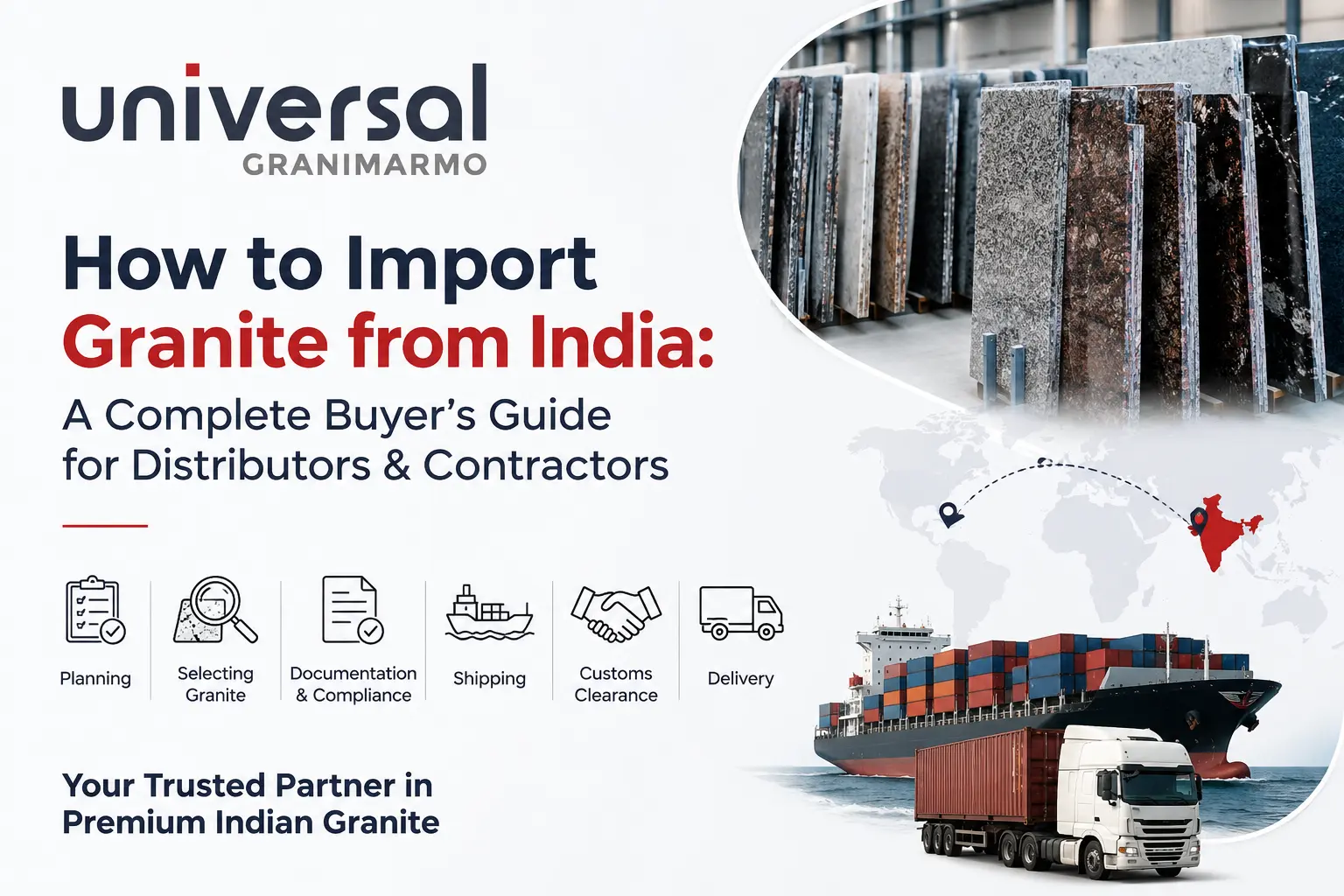
India supplies a large share of the world’s granite, and for good reason. It has some of the most geologically diverse quarries on earth, decades of stone-processing expertise, and a manufacturing base built specifically for export. But “buy from India” and “buy from India well” are two very different things. Get the process right, and you land consistent quality at competitive prices with a reliable, repeatable supply chain. Get it wrong, and you’re dealing with delayed containers, mismatched slabs, and quality disputes with no easy recourse.
This guide walks distributors, contractors, and importers through what actually matters when sourcing granite from India — from picking a supplier to clearing your container at the destination port.
Why Buyers Source Granite from India
India is home to major granite belts across Rajasthan, Telangana, Andhra Pradesh, Karnataka, and Tamil Nadu, producing everything from consistent commercial-grade black and grey granite to rare colors found almost nowhere else. A few things make it a default choice for international buyers:
- Color and material range. Few countries offer this breadth — black, brown, grey, gold, red, blue, pink, green, and white granites all quarried domestically.
- Processing capacity. Established granite hubs like Jalore (“the Granite City of India”), Ongole, and Karimnagar run large-scale cutting, polishing, and finishing operations built around export volumes, not just local demand.
- Price-to-quality ratio. Labor and processing costs remain competitive relative to European or American sources, without sacrificing finish quality when you work with an established exporter.
- Export infrastructure. Major ports (Mundra, Nhava Sheva/JNPT, Chennai, Kolkata) and inland container depots near the granite belts keep logistics relatively efficient.
None of that matters, though, if you don’t understand the process well enough to protect your order.
Step 1: Vet the Exporter, Not Just the Stone
Granite quality varies enormously between suppliers even for the “same” material, because so much depends on the quarry block selected, the processing standards, and quality control at the finishing stage. Before you commit:
- Ask for their own production capacity, not just a trading catalogue. Suppliers who own or directly control quarries and processing units (rather than reselling from multiple unrelated sources) can guarantee more consistency across a large order.
- Request slab-level photos or video from the actual lot, not stock catalogue images. Natural stone has real variation, and you want to see what you’re actually buying.
- Check export history. A supplier that can point to completed international projects — commercial buildings, government contracts, hospitality developments — has already been through the compliance and logistics gauntlet that trips up newer exporters.
- Confirm they handle documentation in-house (or have a dependable freight forwarding partner) rather than leaving you to coordinate customs paperwork independently.
Step 2: Understand How Granite Is Priced
Granite pricing for export typically comes down to a handful of variables, and it helps to know them before you request a quote:
- Material and color. Rarer colors and finishes command a premium over common commercial-grade material.
- Finish. Polished, honed, flamed, leathered, and bush-hammered finishes all carry different processing costs.
- Slab size and thickness. Standard thicknesses (typically in the 15–30mm range for countertops and cladding, thicker for flooring and monuments) affect both material yield and shipping weight.
- Order volume. Bulk orders unlock better per-unit pricing and give you more leverage to request custom cutting or packaging.
- Incoterms. This is where a lot of first-time buyers get confused, and it’s worth its own section.
FOB vs. CIF: Know What You’re Actually Paying For
Two terms will come up in almost every quote:
- FOB (Free on Board): The exporter’s price covers the goods up to the point they’re loaded onto the vessel at the origin port. Everything after that — ocean freight, insurance, destination port charges, customs clearance — is on you (or your freight forwarder).
- CIF (Cost, Insurance, and Freight): The exporter’s price includes shipping and insurance to your destination port. You still handle customs clearance and inland transport from there.
Neither is “better” outright — it depends on whether you already have a trusted freight forwarder and want more control over shipping costs (FOB), or you’d rather have the exporter manage that leg and roll it into one price (CIF). What matters is that both sides are using the term the same way and that the quote explicitly states which Incoterm applies, so you’re comparing quotes on an apples-to-apples basis.
Step 3: Get the Documentation Right
Export documentation is where delays and disputes usually originate — not in the quarry or the factory. A properly organized shipment should include:
- Commercial invoice and packing list, itemizing material, quantity, dimensions, and value per line item.
- Bill of Lading (B/L), your proof of shipment and title to the goods.
- Certificate of Origin, often required to claim preferential duty treatment under trade agreements.
- HS (Harmonized System) code classification specific to natural stone products — get this confirmed by your supplier or customs broker, since misclassification is a common cause of clearance delays and unexpected duty assessments.
- Phytosanitary or fumigation certificates, if wooden crating is used (most destination countries require ISPM-15 compliant packaging for wood pallets/crates).
Duty rates and specific compliance requirements vary by destination country and change over time, so confirm current rates and documentation requirements with a licensed customs broker in your country before finalizing your order — don’t rely on a quote you received a year ago or general guidance from the exporter alone.
Step 4: Set Clear Quality Standards Before Production Starts
Premium quality” means different things to different suppliers. Before your order goes into production, agree in writing on:
- Grading criteria — acceptable range of natural variation, tolerance for visible fissures or pitting, and how off-grade slabs will be handled (rejected, discounted, or replaced).
- Thickness and dimension tolerances — even small variances matter when slabs need to align across a large installation.
- Finish consistency — request a physical sample or approved reference slab that the full order will be matched against.
- Third-party inspection, if the order value justifies it. An independent pre-shipment inspection adds cost but catches problems before the container leaves India rather than after it arrives.
Step 5: Understand Container Loading & Packaging
Granite is heavy, brittle under the wrong stress, and expensive to ship — which makes correct loading non-negotiable:
- Slabs are typically shipped in A-frame crates or bundles, secured to prevent shifting during transit.
- Weight distribution within the container matters both for safety and to avoid additional port handling fees.
- Edge protection and interleaving material between slabs prevent chipping and scratching in transit.
- Confirm whether you’re shipping in a standard or flat-rack container, since oversized slabs or blocks may require flat-rack or open-top configurations.
Ask your supplier for loading photos before the container is sealed — a reputable exporter will provide these as a matter of course.
Step 6: Plan Your Logistics Timeline
A realistic timeline for a first-time order from India typically looks like:
- Sourcing and sampling: 1–3 weeks, depending on how quickly reference slabs can be shipped or approved on video.
- Production: 3–6 weeks for a standard bulk order, longer for custom sizes or rare materials.
- Documentation and pre-shipment inspection: Runs partly in parallel with production, finalized before container loading.
- Ocean freight: Varies significantly by destination — a few weeks to the Middle East, several weeks to Europe or the US East Coast, longer to the US West Coast or Australia depending on routing.
- Customs clearance at destination: Highly dependent on your country’s process and how clean your documentation is.
Build buffer time into your project schedule, especially for a first order with a new supplier — first shipments often reveal friction points that get smoothed out on repeat orders.
Common Mistakes First-Time Buyers Make
- Ordering purely on price without vetting production capacity or export history.
- Skipping a physical or video sample review and relying only on catalogue photos.
- Not confirming Incoterms explicitly, leading to disputes over who owns which cost.
- Underestimating lead time and committing to a project schedule before production timelines are confirmed.
- Leaving documentation to the last minute is the single biggest cause of port delays.
Working with an Established Exporter
The friction points above are largely avoidable by working with a supplier that has already built the infrastructure to handle them — in-house production across multiple quarrying regions, documented export history to government and commercial projects internationally, and a team that manages customs paperwork rather than leaving it to you.
If you’re sourcing granite, marble, sandstone, limestone, or quartz for a distribution, contracting, or project pipeline, get in touch with our team for bulk pricing, custom sizing, and a catalogue of available materials — or download our full product catalogue to see the current range.