
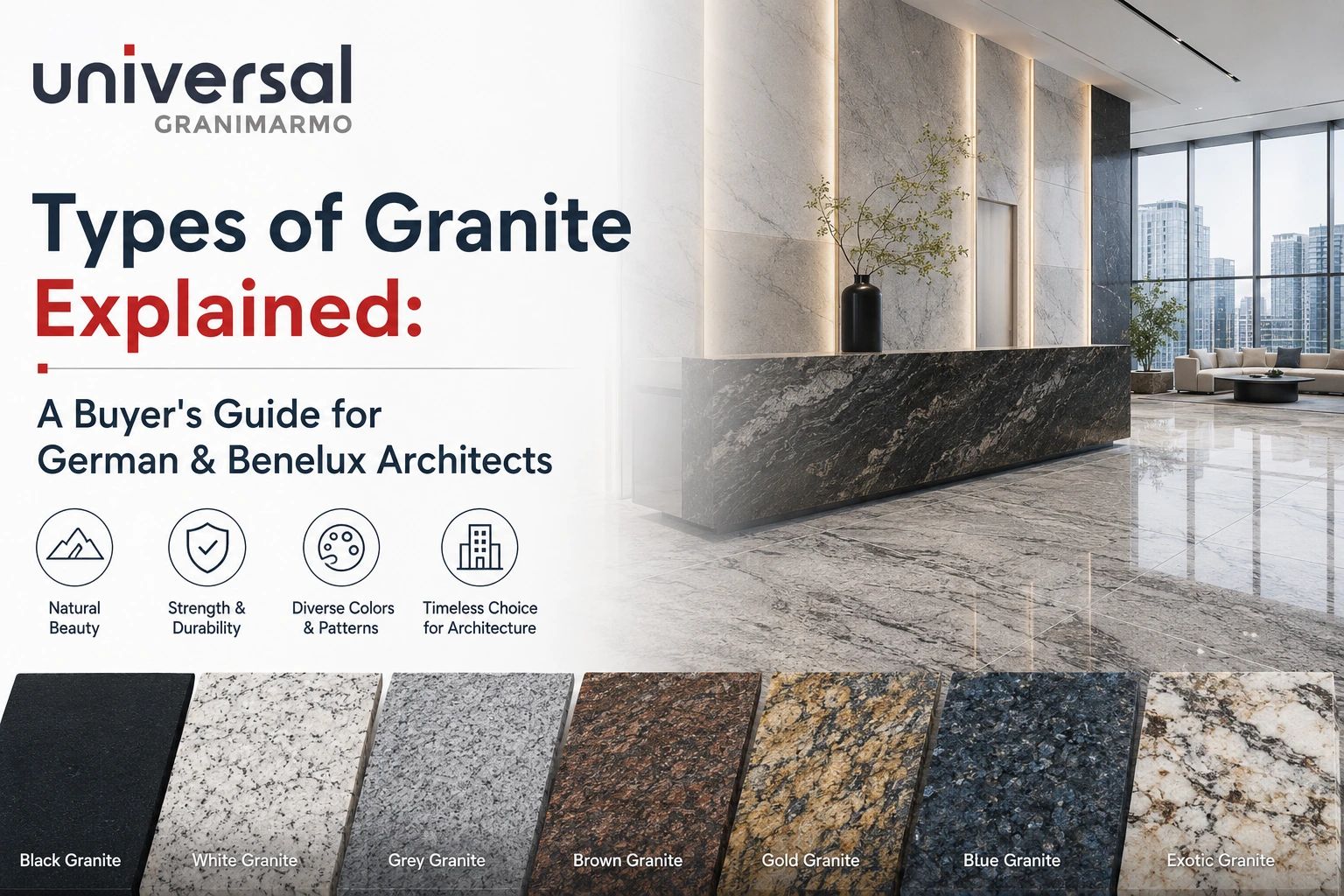
Architects and specifiers across Germany, the Netherlands, and Belgium work within some of Europe’s most exacting building standards — DIN specifications in Germany, NEN standards in the Netherlands, and equivalent Belgian codes all demand materials with predictable, well-documented performance. Granite meets that bar reliably, but only if you understand the differences between the types available and how to specify the right one for the application.
This guide breaks down granite types by composition, finish, and origin, so specification decisions are based on performance data rather than appearance alone.
Granite Types by Colour and Mineral Composition
Granite’s colour comes from its mineral content — primarily quartz, feldspar, and mica — and this composition also affects hardness, porosity, and how the stone weathers over time.
- Black granite — typically higher in mafic minerals, giving excellent density and a dramatic, uniform appearance often specified for feature walls, reception areas, and monument work. See the full black granite range.
- White and light granite — quartz- and feldspar-rich, popular for bright interiors, facades, and countertops where a clean, contemporary look is required. Browse white granite options.
- Grey granite — one of the most versatile and widely specified types across Northern European commercial and residential projects, pairing well with both glass-and-steel facades and traditional brick. See grey granite.
- Red and brown granite — iron-oxide-rich varieties suited to heritage-style projects, paving, and feature cladding where warmth and visual weight are needed. Explore red granite and brown granite.
The full granite stone catalogue covers additional colour variants including green, gold, pink, and blue granite for projects needing a less common specification.
Granite Types by Finish
Beyond colour, the surface finish significantly changes both appearance and technical performance — an important consideration for German, Dutch, and Belgian projects where slip resistance and weathering standards are strictly regulated.
- Polished — high-gloss, reflective finish; best for interior flooring, countertops, and feature walls where slip resistance isn’t a primary concern
- Honed — matte, low-sheen finish with a smoother surface than flamed granite; suited to both interior and lower-traffic exterior use
- Flamed (thermal) — textured, slip-resistant finish created by rapid heat treatment; the standard specification for exterior paving, steps, and public plazas across Northern Europe
- Leathered — a textured but low-sheen finish that hides fingerprints and water spots well, increasingly specified for kitchen countertops and vanities
Granite Types by Application
For architects working across mixed-use developments, the practical question is usually which type suits which application:
- Facades and cladding — favour dense, low-porosity granites in grey, black, or brown tones with a flamed or honed finish for weather resistance
- Interior flooring — polished or honed granite in lighter tones performs well and is easier to maintain in high-footfall commercial lobbies
- Kitchen and bathroom countertops — white, grey, or black granite with a polished or leathered finish balances aesthetics with heat and stain resistance
- External paving and steps — flamed granite is standard practice across Germany, the Netherlands, and Belgium for its slip-resistant surface in wet, temperate conditions
Sourcing Considerations for German & Benelux Projects
Specification is only half the process — sourcing consistent material at project scale is where many imported-stone projects run into difficulty. When evaluating a granite supplier, architects should confirm:
- Technical data sheets covering density, water absorption, and compressive strength for each granite type specified
- Batch consistency across the full quantity required, particularly for large facade or flooring runs
- Experience shipping and documenting material for EU customs and construction compliance requirements
- Availability of physical samples and, where needed, larger format mock-up panels before full production
Universal Granimarmo has exported granite, marble, sandstone, and slate from India since 2013, with production spanning Rajasthan and southern India. That breadth of quarry access is what allows specifiers to source a genuinely wide range of granite types — colour, finish, and format — from a single accountable supplier. Read more about the company and its export journey.
Frequently Asked Questions
What is the strongest type of granite?
Strength varies by quarry rather than colour alone, but generally darker, mafic-mineral-rich granites (such as black and dark grey varieties) tend to have higher density and compressive strength, making them well suited to heavy-use flooring and facade applications.
Which granite finish is best for exterior paving in wet climates?
Flamed (thermal) finish is the standard recommendation for exterior paving and steps in Germany, the Netherlands, and Belgium, since the heat-treated texture provides significantly better slip resistance in wet or icy conditions than polished or honed finishes.
How is granite different from natural stone like sandstone or slate?
Granite is an igneous rock formed from cooled magma, giving it high density, low porosity, and greater hardness than sedimentary stones like sandstone or metamorphic stones like slate. This makes granite generally more durable for high-traffic or exterior applications.
Can granite meet DIN and NEN building standards?
Yes, when supplied with proper technical documentation. Reputable exporters provide test data on water absorption, density, and compressive strength, which specifiers can cross-reference against DIN (Germany) or NEN (Netherlands) requirements for the specific application.
How do I choose between polished and honed granite for a commercial lobby?
Polished granite offers a more reflective, formal appearance but can be slippery when wet, so it’s best for controlled indoor environments. Honed granite offers a similar aesthetic with better slip resistance, making it a safer choice for entrance areas exposed to rain or foot traffic carrying moisture.
Is Indian granite consistent enough for large commercial projects?
Yes, provided it’s sourced from a supplier with sufficient quarry and processing capacity. Large-scale exporters can supply matched batches for facade, flooring, or paving runs across an entire project, which is essential for maintaining visual consistency at scale.