
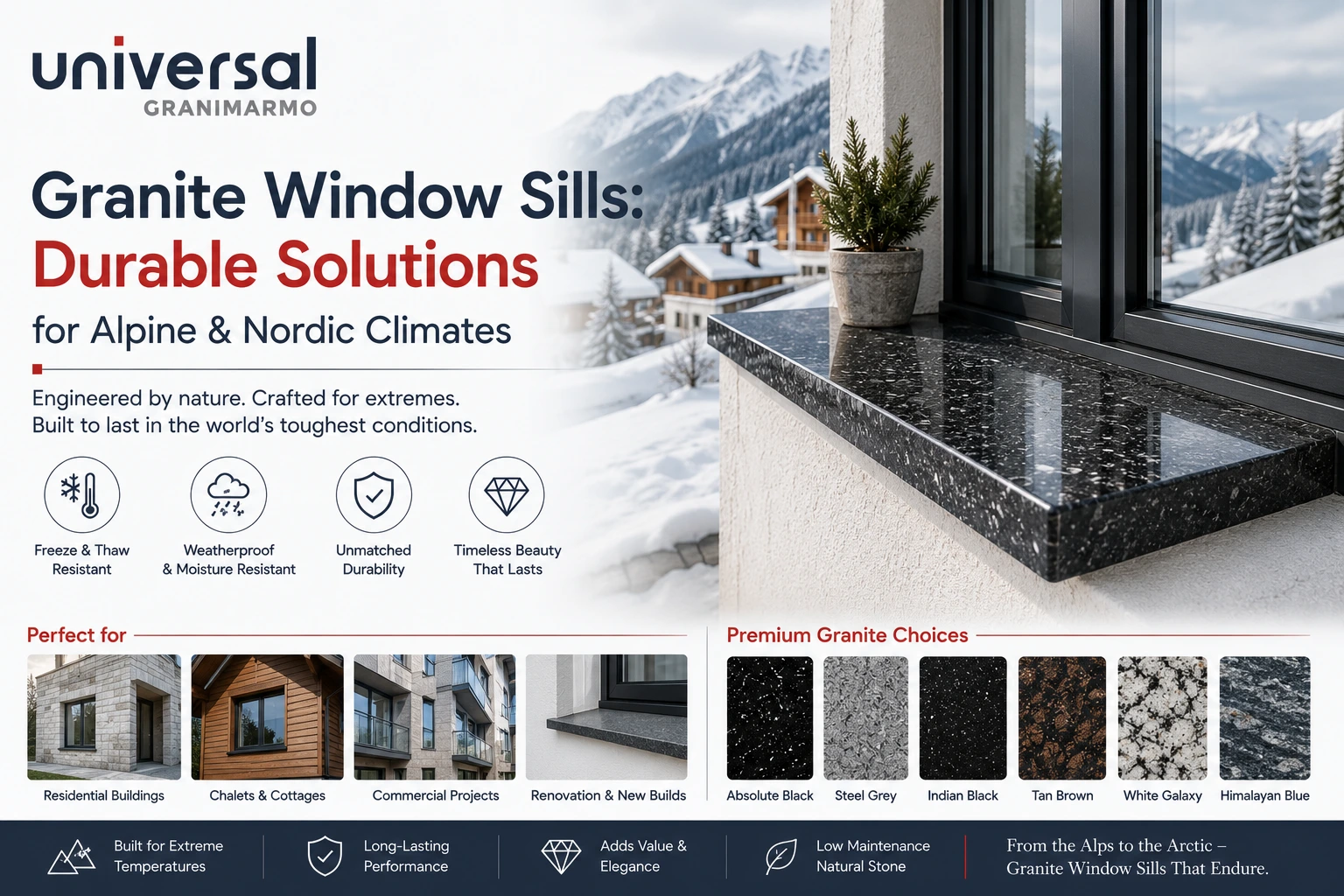
Granite Window sills rarely get the attention they deserve in a build or renovation project, right up until the moment they fail. In Austria and Switzerland, that failure usually shows up as a hairline crack after a hard winter freeze. In Denmark, it’s more often water ingress and staining from months of driving rain. Both are avoidable problems, and both come down to the same root cause: the wrong material specified for a climate that shows no mercy to anything porous, brittle, or poorly finished.
Granite window sills solve this problem more reliably than almost any alternative, and this guide covers exactly why — the material science behind it, how it performs specifically in Alpine and Nordic conditions, installation considerations, and what to check before ordering.
Why Window Sills Matter More in Alpine and Nordic Climates
A window sill does two jobs that are easy to overlook: it sheds water away from the building envelope, and it absorbs constant thermal cycling as temperatures swing between interior warmth and exterior cold. In milder, drier climates, a mediocre material can get away with underperforming at both tasks for years. In Austria’s and Switzerland’s Alpine regions, and across Denmark’s damp, wind-driven coastal climate, there’s no such tolerance.
Consider what a windowsill actually endures in these regions over a typical year:
Freeze-thaw cycling — water that penetrates a porous material expands when it freezes, and repeated cycles crack or spall the surface over just a few winters Persistent moisture — Denmark in particular sees high annual rainfall and humidity, keeping exterior sills wet for extended periods UV and thermal exposure — south-facing sills in Alpine regions see intense summer sun exposure at altitude, which degrades weaker materials faster than at sea level Snow load and de-icing salt exposure — sills near roof lines or balconies can be exposed to compacted snow and the salts used to melt it, both of which are corrosive to softer stones and concrete
Granite is one of the few materials that resists all four of these stresses simultaneously, which is why it has become the default specification for architects working across the Alpine and Nordic regions.
The Material Science: Why Granite Resists Freeze-Thaw Damage
Freeze-thaw damage happens when water enters a material’s pore structure, then expands by roughly 9% as it freezes. In porous stones like sandstone, limestone, or poorly sealed concrete, this expansion gradually forces micro-cracks to widen, eventually causing visible spalling or flaking at the surface.
Granite’s igneous origin — formed from slowly cooled magma deep underground — gives it an unusually tight, interlocking crystalline structure with very low porosity, typically well under 1% water absorption in quality material. With so little water able to penetrate the stone in the first place, there’s very little opportunity for freeze-thaw expansion to cause damage. This single property is the main reason granite window sills routinely outlast alternatives by decades in the exact conditions Austria, Switzerland, and Denmark experience every winter.
Granite vs Other Window Sill Materials
It’s worth comparing granite directly against the materials most commonly proposed as alternatives:
- Precast concrete — cheaper upfront, but far more porous than granite, meaning it absorbs water readily and is prone to cracking, staining, and surface erosion within a decade in freeze-thaw climates
- Marble — softer and more porous than granite, with a tendency to etch and stain from acidic rain or pollution exposure over time, making it a poor choice for exterior sills despite its aesthetic appeal
- Sandstone — a traditional choice in parts of Central Europe, but its higher porosity makes it considerably more vulnerable to freeze-thaw spalling than granite
- Timber — requires frequent maintenance and refinishing, and is vulnerable to rot and insect damage in consistently damp Nordic conditions
- uPVC or composite — durable against moisture but can discolour, warp slightly under intense summer sun at altitude, and lacks the visual weight and permanence of natural stone on a period or high-end property
Granite is the only material on this list that combines near-zero water absorption, high compressive strength, resistance to UV degradation, and long-term aesthetic stability — without an ongoing maintenance burden.
Best Granite Types for Window Sills in These Climates
Not all granite performs identically, and colour choice for window sills is often driven by both climate practicality and regional architectural style:
- Grey granite — the most commonly specified choice across Austrian and Swiss Alpine architecture, blending naturally with stone, render, and timber facades. See the grey granite range.
- Black granite — offers a dramatic, high-contrast look against white or pastel-rendered facades common in Danish residential architecture, and its density makes it particularly resistant to weathering. Explore black granite.
- White and light granite — increasingly specified for contemporary Nordic-style new builds where a brighter, minimalist facade palette is preferred. Browse white granite.
The broader granite stone catalogue covers further colour options for matching an existing facade or roofline material.
Finish Considerations for Exterior Sills
Finish affects both weathering performance and day-to-day practicality:
- Flamed (thermal) finish — the most common specification for exterior sills in wet or icy climates, since the heat-textured surface improves grip and reduces the visible impact of minor surface weathering over time
- Honed finish — a smoother matte option that still performs well outdoors, often chosen where a more refined appearance is wanted without the high-gloss look of polished stone
- Polished finish — generally reserved for interior sills only, since a high-gloss surface can become slippery when wet and shows water spotting more visibly outdoors
Installation Considerations for Alpine and Nordic Projects
Even the right material can underperform if installation details are overlooked. Architects and installers working in these climates typically specify:
- A pronounced drip groove on the underside of the sill, so water sheds away from the facade rather than running back against the wall and causing staining or damp penetration
- A slight outward slope (fall) across the sill’s top surface, ensuring water doesn’t pool against the window frame
- Correctly sized overhangs beyond the facade line, since Alpine snow loads and Nordic driving rain both benefit from sills that project further than in milder climates
- Appropriate sealant at the sill-to-frame junction, using a flexible, weather-rated sealant that can accommodate thermal movement without cracking
Common Mistakes to Avoid When Specifying Granite Sills
Even with the right material chosen, a handful of recurring mistakes show up on Alpine and Nordic projects, and they’re worth flagging explicitly:
- Treating sill fabrication as an afterthought. Sills are often specified late in a project, after facade materials and window frames are locked in, which can lead to rushed ordering and mismatched batches. Building sill specification into the earlier design phase avoids this.
- Skipping the drip groove detail to save fabrication cost. This small feature has an outsized effect on long-term facade staining and damp penetration, and omitting it is one of the most common — and most regretted — cost-cutting decisions on a renovation.
- Choosing a polished finish for exterior use because it looked good on an interior sample. Polished granite that performs beautifully as a kitchen countertop indoors can become a genuine slip hazard on an exterior sill exposed to rain, frost, or snowmelt.
- Underestimating lead times for large developments. Multi-unit residential projects requiring dozens of matched sills need more advance ordering time than a single chalet renovation, and leaving this until late in the construction schedule often forces compromises on batch consistency.
Sourcing Granite Window Sills for Alpine and Nordic Projects
Sourcing at project scale — whether for a single Alpine chalet renovation or a multi-unit Danish residential development — requires a supplier who can guarantee consistent colour and finish across potentially hundreds of individual sill pieces, along with technical documentation to satisfy building compliance requirements in each country.
Universal Granimarmo has exported granite, marble, sandstone, and slate since 2013, with production spanning multiple quarry units across Rajasthan and southern India. This scale allows consistent batch supply for large residential or commercial projects, along with technical data on density, water absorption, and compressive strength for architects who need to document material performance. Learn more about the company and its export journey.
A Specification Checklist Before Ordering
- Confirm water absorption data for the specific granite type — quality material should test well under 1%
- Specify finish based on location — flamed or honed for exterior sills, polished reserved for interior use only
- Order full-project quantity from one batch to avoid visible colour variation across multiple sills on the same facade
- Confirm drip groove and fall detailing are included in the fabrication specification, not left to on-site adjustment
- Request compressive strength and freeze-thaw resistance data if compliance documentation is required for the project
- Check realistic lead times factoring in quarrying, fabrication, and shipping to Austria, Switzerland, or Denmark specifically
Frequently Asked Questions
Can granite window sills crack in extreme cold?
Quality granite with low water absorption (well under 1%) is highly resistant to freeze-thaw cracking, since there is minimal water able to penetrate the stone and expand during freezing. This is precisely why granite is preferred over more porous materials in Alpine and Nordic climates.
What’s the best granite finish for exterior window sills in wet climates?
A flamed (thermal) finish is generally recommended for exterior sills, since the textured surface improves grip and better disguises minor surface weathering over years of exposure, compared to a polished finish.
How thick should a granite window sill be?
Most residential window sills are cut from 20-30mm thick granite, though exact thickness depends on the sill’s projection beyond the facade and the specific loading or overhang requirements of the project.
Do granite window sills need sealing?
Exterior granite sills benefit from an initial seal on installation, but due to granite’s naturally low porosity, they require far less frequent resealing than porous stones like sandstone or limestone — often only needing attention every few years, if at all, depending on the specific granite type.
Is granite more expensive than concrete or uPVC window sills?
Granite typically costs more upfront than precast concrete or uPVC, but its significantly longer lifespan and resistance to cracking, staining, and discolouration in freeze-thaw climates generally make it more cost-effective over the life of the building.
Can granite window sills discolour over time from de-icing salt exposure?
Granite is far more resistant to salt-related staining and surface degradation than porous stones or concrete, thanks to its low porosity, though sills in direct, repeated contact with compacted salted snow should still be rinsed periodically as routine maintenance.
What colour granite is best for a traditional Alpine chalet renovation?
Grey granite is the most commonly specified choice for Alpine chalet renovations, as it blends naturally with traditional stone, timber, and render facades without looking overly modern or out of place against existing architecture.
How do I ensure consistent colour across sills on a large development project?
Order the full project quantity from a single supplier batch wherever possible, and request slab or block photography before fabrication to confirm consistency, particularly for developments requiring dozens or hundreds of matching sills.
How long does it take to source and install granite window sills for a project in Austria, Switzerland, or Denmark?
Lead times vary by project scale, but buyers should generally allow for several weeks to a few months from order confirmation through fabrication and shipping, with additional time needed for larger developments requiring extensive batch matching.