
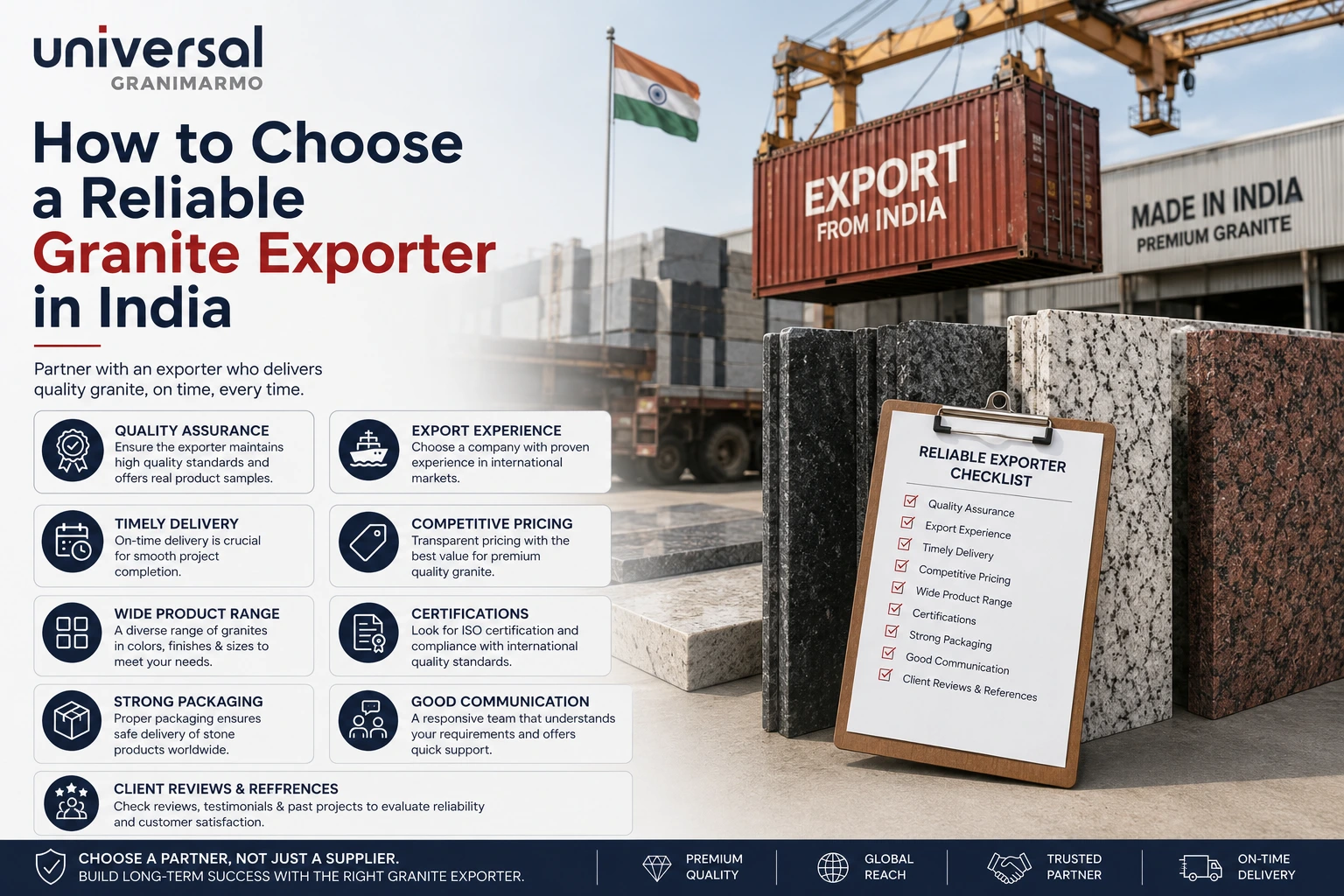
India is one of the largest sources of natural granite in the world, supplying slabs, tiles, and monuments to buyers across the USA, Europe, the Middle East, and beyond. But with hundreds of exporters competing for business, choosing the wrong one can mean delayed shipments, inconsistent quality, or costly disputes over grading and pricing.
If you’re sourcing granite for a construction project, retail business, or countertop fabrication line, here’s what actually separates a dependable exporter from a risky one.
1. Check Their Quarry and Factory Access
The biggest quality risk in granite sourcing is buying from a trader who doesn’t control their own supply chain. Exporters who own or have direct ties to quarries and processing units can guarantee consistent color, veining, and slab thickness across large orders — something a middleman reselling from multiple sources usually can’t promise.
Ask directly: Does the exporter operate its own factories? Where are they located? India’s major granite belts include Rajasthan (Jalore, Ajitgarh), Andhra Pradesh (Ongole), and Telangana (Karimnagar) — each known for specific colors and stone types, like Ongole’s Black Galaxy granite.
2. Look for Documented Export Experience
A reliable exporter should be able to show:
- Years in the export business (not just domestic sales)
- A track record of international projects — hotels, government buildings, residential developments
- Familiarity with export documentation: HS codes, certificates of origin, phytosanitary certificates where required, and customs paperwork for your destination country
Exporters who’ve shipped to demanding markets (Gulf countries, the EU, North America) tend to have tighter quality control, since these markets often have stricter inspection standards.
3. Understand Their Grading System
Granite is typically sold in grades — commercial, standard, and premium (sometimes labeled A1, A2, A3). A trustworthy exporter will explain their grading criteria clearly and be willing to show you sample photos or arrange a video call inspection of the actual lot, not just a catalog image. Be cautious of suppliers who are vague about grading or reluctant to provide slab-specific photos before shipment.
4. Ask About Customization Capability
Projects often need non-standard sizes, finishes (polished, flamed, leathered, honed), or edge profiles. Exporters with in-house processing units can typically accommodate custom cutting and finishing without adding weeks to your timeline, since the work doesn’t have to be outsourced to a third-party unit.
5. Get Clear, Written Pricing Terms
Bulk granite pricing depends on several factors: stone rarity, slab size, finish, order volume, and shipping terms (FOB vs CIF). A reliable exporter will:
- Provide itemized quotations, not vague lump-sum pricing
- Clearly state whether the quote is FOB (you arrange shipping) or CIF (shipping included)
- Be transparent about payment terms and any advance requirements
If a quote seems significantly lower than competitors with no clear explanation, treat it as a red flag rather than a bargain.
6. Review Their Shipping and Logistics Process
Ask how they handle container loading, since granite slabs are heavy and prone to damage if not packed correctly. Reliable exporters use reinforced crating, proper slab bracing inside containers, and can share their standard loading procedure or photos from past shipments. Also confirm realistic lead times — from order confirmation to port departure — rather than accepting overly optimistic timelines that often slip.
7. Check References and Past Projects
Established exporters are usually willing to share details of past international projects — government buildings, hotels, or large residential developments — along with buyer references. A supplier with nothing to show beyond their own website listings is harder to vet.
8. Evaluate Communication and Responsiveness
This sounds basic, but it’s one of the most reliable indicators of how an exporter will handle problems if something goes wrong mid-order. Slow, vague, or inconsistent communication during the inquiry stage is a strong predictor of the same during production and shipping.
Final Thoughts
Choosing a granite exporter in India isn’t just about finding the lowest price — it’s about finding a partner with verified sourcing, transparent grading, realistic logistics, and a track record that holds up under scrutiny. Take the time to ask direct questions, request documentation, and, where possible, verify claims with references or site visits before committing to a large order.
Frequently Asked Questions
1. What is the difference between a granite exporter and a granite trader?
An exporter with its own quarries and processing units controls quality and supply directly, while a trader typically resells stone sourced from multiple third parties. Traders can still be reliable, but quality consistency across large orders is harder to guarantee.
2. How do I verify a granite exporter’s credentials before placing an order?
Ask for their export history, GST/IEC registration, past shipment references, and photos or videos of their factory and quarry. Reputable exporters are usually happy to arrange a video call inspection or share verifiable project references.
3. What is the minimum order quantity (MOQ) for granite exports from India?
This varies by exporter, but most B2B suppliers work in container-load quantities (typically one 20ft or 40ft container per order) rather than small retail quantities, since granite is priced and shipped in bulk.
4. What’s the difference between FOB and CIF pricing?
FOB (Free on Board) means the exporter’s price covers the goods up to loading onto the ship, and the buyer arranges and pays for shipping from there. CIF (Cost, Insurance, and Freight) means the exporter’s quote already includes shipping and insurance to your destination port.
5. How long does it take to receive a granite export order? Timelines depend on order size, customization, and destination, but a typical order takes several weeks for processing and quality checks, plus additional transit time by sea freight — often totaling 4–8 weeks door-to-port, depending on the route.
6. How is granite graded, and does grade affect price?
Granite is generally graded by color consistency, absence of cracks or fissures, and pattern uniformity (often labeled commercial, standard, or premium/A1 grade). Higher grades cost more but offer more consistent slabs with fewer visible imperfections.
7. Can I get custom sizes, thicknesses, or finishes for my project?
Most established exporters with in-house processing can accommodate custom cutting, polishing, and finishes like flamed, leathered, or honed surfaces — though lead times may be longer than for standard stock sizes.
8. What documents should I expect to receive with a granite export shipment?
Standard documentation includes a commercial invoice, packing list, certificate of origin, bill of lading, and any additional certificates required by your destination country’s customs authority.
Looking for a granite exporter with in-house quarrying, processing, and over a decade of export experience? Get in touch with our team or download our catalogue to see our full range of granite, marble, and natural stone.