
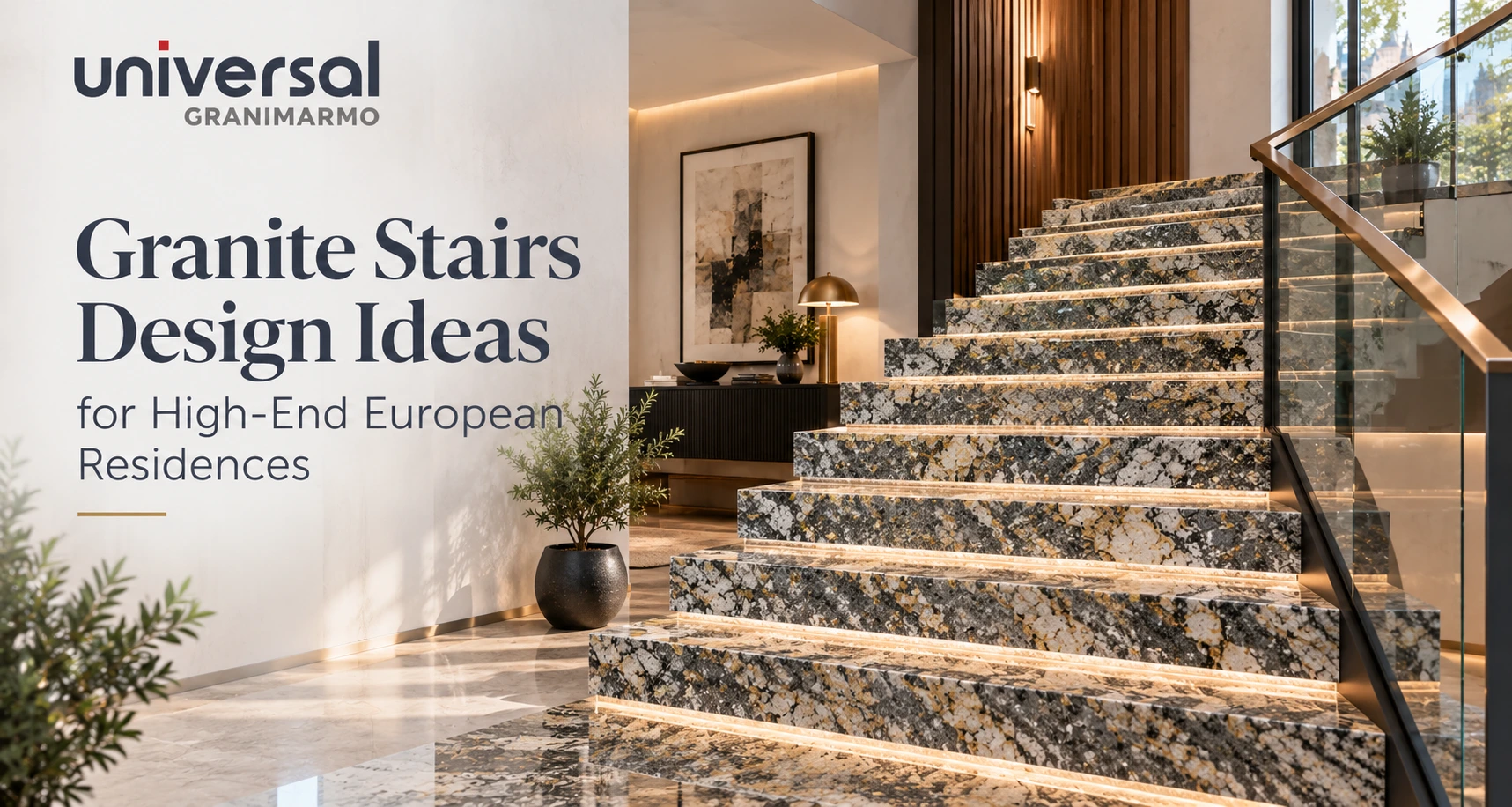
A staircase is rarely just a way to get from one floor to another. In high-end residences across Luxembourg, Monaco, and Liechtenstein, it’s often the single most photographed, most discussed architectural feature in the home — the first thing a visitor encounters and the backdrop for countless family photos over decades. Granite has become the material of choice for these statement staircases, offering a combination of visual weight, durability, and design flexibility that few alternatives can match.
Why Granite Works So Well for Statement Staircases
Staircases endure more concentrated wear than almost any other surface in a home — repeated foot traffic on a narrow tread area, constant edge exposure, and in many entryways, direct sunlight from adjacent windows or skylights. Granite handles all of this better than softer stones:
- High resistance to wear — granite’s hardness means stair treads keep their finish and edge definition far longer than marble or limestone under repeated use
- Structural strength — granite’s compressive strength makes it suitable for cantilevered or floating stair designs that require the material to bear significant load
- Design flexibility — available in a vast range of colours, patterns, and finishes, allowing a staircase to be a genuine design statement rather than a purely functional element
Popular Granite Stair Design Styles
The Monolithic Statement Staircase
A single, dominant granite colour — often a dramatic black or deep grey — used consistently across treads, risers, and sometimes the surrounding balustrade wall. This style creates a bold, sculptural presence often seen in contemporary Monaco penthouses and new-build villas. See the black granite range.
The Book-Matched Feature Wall Staircase
Granite slabs cut from the same block and arranged so the veining mirrors across a staircase’s adjacent wall, creating a striking, almost artistic backdrop. This technique is particularly effective with pure white or lightly veined granite and is increasingly requested for Luxembourg’s more discreet, design-forward private residences.
The Floating Tread Staircase
Individual granite treads appear to float without visible support, typically achieved with a hidden steel structure beneath. This design relies heavily on the stone’s strength and consistent finish quality, since each tread is fully exposed and visually isolated — flaws or inconsistencies are far more noticeable than in a traditional enclosed staircase.
The Contrast Staircase
Pairing two granite colours — commonly a light tread with a dark riser, or vice versa — to add visual rhythm and definition to each step. This approach works particularly well in homes blending traditional and contemporary design elements, a common brief in Liechtenstein’s mix of historic and newly built luxury properties.
The Curved or Spiral Granite Staircase
Among the most technically demanding designs to fabricate, requiring precisely cut curved treads that maintain consistent colour and pattern across the full curve. When executed well, a curved granite staircase becomes an unmistakable centrepiece, often positioned as the focal point of a grand entryway.
Choosing the Right Granite Colour for a Statement Staircase
- Black granite — dramatic, formal, and pairs well with brass or brushed gold fixtures for a strong contemporary statement
- Pure white granite — bright and monumental, particularly effective for book-matched feature walls and light-filled entryways. See pure white granite options.
- Grey granite — a versatile middle ground that suits both traditional and contemporary interiors without dating quickly
- Warm brown or beige granite — suited to more classical, heritage-style residences common across parts of Luxembourg and Liechtenstein
Browse the full granite stone catalogue for additional colour options to match a specific interior palette.
Finish Considerations for Stair Treads
Finish choice matters more on stairs than almost any other application, since safety and appearance both depend on it:
- Honed finish — the most common choice for stair treads, offering a refined matte look with meaningfully better grip than polished granite
- Leathered finish — a subtly textured surface that provides excellent slip resistance while still reading as a premium, high-end finish
- Polished finish — visually striking but generally reserved for risers or surrounding wall cladding rather than the tread surface itself, due to reduced slip resistance
Many high-end projects use a polished finish on risers and a honed or leathered finish on treads, combining visual drama with everyday safety.
Practical Considerations Before Specifying Granite Stairs
- Order all slabs from a single batch to ensure colour and veining consistency across every tread and riser
- Confirm nosing details — the front edge of each tread, which can be bullnosed, chamfered, or square depending on the overall design language of the home
- Discuss book-matching requirements early if a feature wall or dramatic veining effect is wanted, since this requires specific slab selection at the quarry or processing stage
- Factor in fabrication lead time for curved or floating stair designs, which require more precise cutting than standard straight staircases
Sourcing Granite for a High-End Staircase Project
Universal Granimarmo has exported granite, marble, sandstone, and slate from India since 2013, with production spanning Rajasthan and southern India — giving architects and private clients access to book-matching capability and consistent large-format slabs suited to statement staircase projects. Learn more about the company and its export journey.
Frequently Asked Questions
What’s the best granite finish for stair treads?
A honed or leathered finish is generally recommended for stair treads, as both offer significantly better slip resistance than a polished finish while still delivering a refined, high-end appearance.
Can granite be used for floating or cantilevered staircases?
Yes. Granite’s high compressive strength makes it suitable for floating tread designs, though this depends on proper structural engineering beneath the visible stone and consistent slab quality across every tread.
What is book-matching, and does it work for staircases?
Book-matching involves cutting slabs from the same block and arranging them so veining mirrors across an adjacent surface, such as a staircase and its neighbouring wall. It’s an effective technique for creating a striking, cohesive design statement in entryways.
How do I avoid visible colour differences between stair treads?
Order all required slabs from a single supplier batch, ideally cut from the same or adjacent quarry blocks, and request slab photography for approval before fabrication begins.
Is granite more slippery than other stair materials?
A polished granite finish can be more slippery than some alternatives, but honed or leathered finishes offer grip comparable to, or better than, many other natural stone or tiled stair surfaces, making finish choice more important than the material itself.
How long does it take to source and fabricate a custom granite staircase?
Lead times vary by design complexity — a straight staircase with standard treads takes less time than a curved or book-matched feature design, which requires more precise slab selection and cutting. Buyers should discuss realistic timelines with their supplier early in the design process.
Can granite stair designs be combined with other materials like glass or steel balustrades?
Yes, granite pairs well with glass, steel, and brass balustrade systems, and this combination is common in contemporary high-end residences seeking a blend of natural stone warmth with modern architectural detailing.