
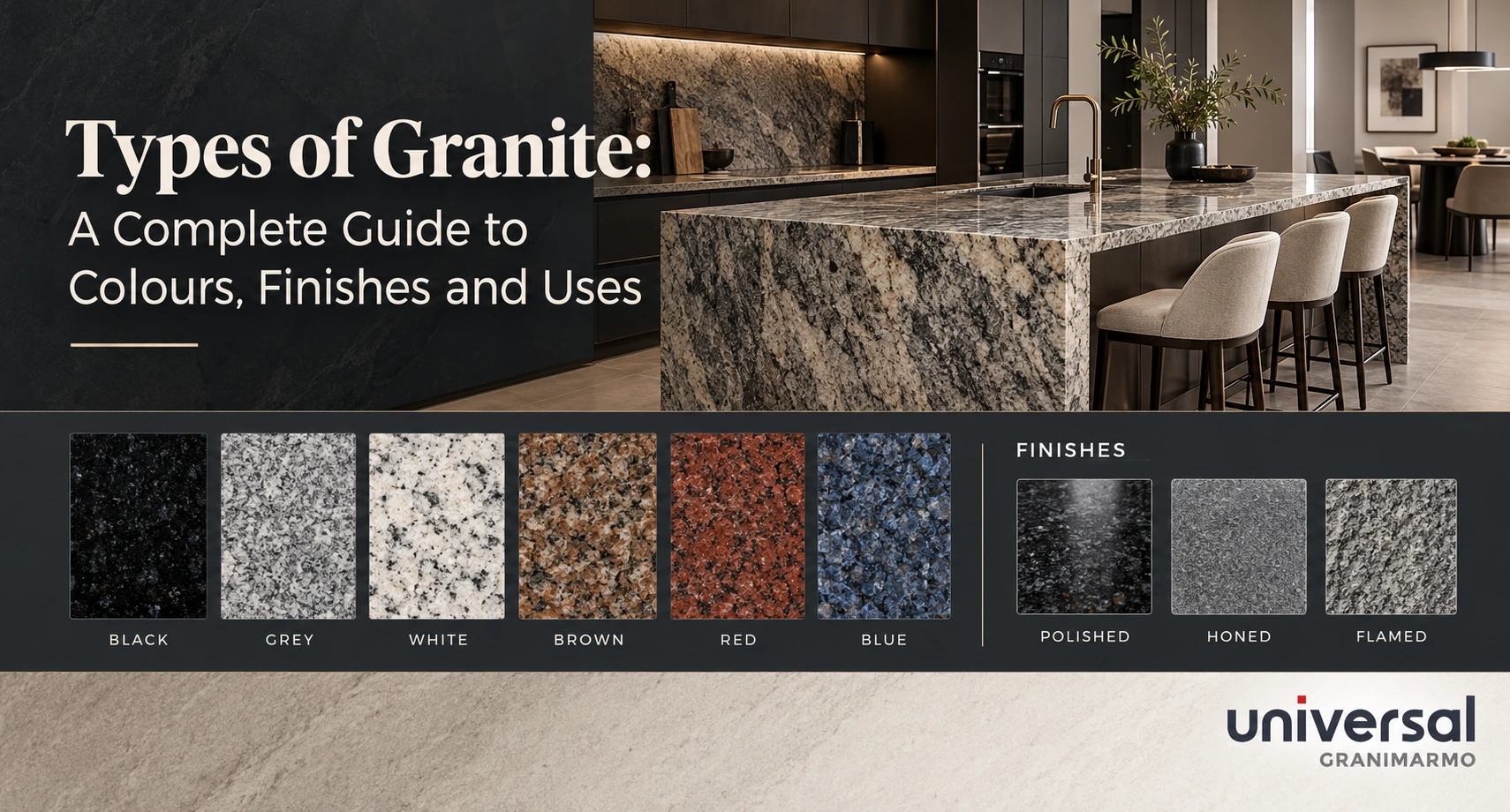
Granite comes in ten main colour families (black, white, grey, brown, red, pink, blue, green, golden and yellow), five common surface finishes and a wide range of uses, from kitchen worktops to stairs and outdoor paving. Which type is right for you depends on where it will be used, how much traffic it will take and the look you want.
This guide explains every major type of granite, how finishes change the look and grip of the stone, and which types suit which projects. It is written for homeowners, architects and importers across the UK and Europe.
What is granite?
Granite is a hard igneous rock formed when molten magma cools slowly underground. It is made mainly of quartz, feldspar and mica, and the mix of these minerals decides its colour and pattern. Because the crystals interlock, granite is dense, scratch-resistant and strong, which is why it has been used for floors, stairs, worktops and monuments for centuries.
No two quarries produce the same stone, and no two slabs from the same block look identical. That is why the trade talks about types of granite rather than one product. You can sort the types in three useful ways:
- By colour, which sets the look of the stone and where it works best.
- By finish, which sets the surface texture, shine and grip.
- By use, which sets the thickness, strength and standards the stone must meet.
Some buyers also sort by origin. Stone from North India and South India, for example, differs in grain and colour range, and Rajasthan, Andhra Pradesh and Telangana are three of the main producing regions.
Types of granite by colour
Colour is the first thing most buyers choose, and it also hints at how the stone behaves. Dark stones hide marks and suit busy kitchens. Light stones brighten small rooms but show variation more clearly. The table gives a quick overview, followed by notes on the families buyers ask about most.
| Colour family | Typical look | Common uses | Product page |
|---|---|---|---|
| Black | Deep black, plain or with gold or silver flecks | Worktops, flooring, monuments, paving | Black granite |
| White | White base with grey, black or brown speckle or veining | Worktops, islands, flooring, cladding | White granite |
| Grey | Light to charcoal grey, even or speckled | Paving, facades, kerbs, flooring | Grey granite |
| Brown | Warm brown with gold and cream grains | Worktops, flooring, stairs | Brown granite |
| Red | Bold red to deep burgundy | Facades, paving, memorials, flooring | Red granite |
| Pink | Soft pink with grey and black grains | Cladding, paving, flooring | Pink granite |
| Blue | Blue to blue-grey with silvery shimmer | Feature surfaces, worktops, interiors | Blue granite |
| Green | Green to dark green with lighter crystals | Feature walls, worktops, decorative areas | Green granite |
| Golden | Gold and amber tones with dark grains | Worktops, flooring, stairs | Golden granite |
| Yellow | Cream to yellow with brown grains | Flooring, cladding, paving | Yellow granite |
Black granite
Black is the most requested colour for worktops and flooring because it is dramatic, hides stains and pairs with almost any cabinet colour. Within it you will find plain, uniform blacks and stones with sparkle. Black Galaxy, quarried near Ongole in Andhra Pradesh, is known for its small golden flecks that catch the light. Rajasthan also produces black granite, often chosen for its clean, consistent tone. See our detailed guide to black granite for the full range.
White granite
White granite is rarely pure white. Most stones sold as white have a white or cream base with grey, black or brown speckles and veins. Names such as Kashmir White and Alaska White are widely used in the trade for this style. Light worktops make small kitchens feel larger, though the movement in the stone is easier to see than in black. Our white granite page shows the options, and we explain the shade differences in our guide to granite white colour.
Red and pink granite
Red granite owes its colour to feldspar rich in iron minerals. It is a favourite for facades, memorials and paving where a strong colour is wanted. Lakha Red, associated with Rajasthan, is one of the best-known names in this family. Pink granite is softer in tone and works well for cladding and outdoor paving.
Grey, brown, golden and yellow granite
Grey granite is the workhorse of outdoor projects, used for kerbs, paving and facades because it is strong and easy to match across large areas. Brown, golden and yellow granites bring warmth to floors, stairs and worktops, and they hide dust and footprints better than very light stones.
Blue and green granite
Blue and green granites are rarer and are chosen for statement surfaces. Their colour comes from specific minerals and varies a lot from block to block, so always approve the exact slabs before ordering. If you are weighing green granite against green marble, remember that granite is harder and better suited to kitchens and outdoor use.
Types of granite by finish
The finish changes how the same stone looks and feels. It also changes how slippery the surface is, which matters on stairs, terraces and wet areas.
| Finish | Look and feel | Grip | Best for |
|---|---|---|---|
| Polished | Glossy, mirror-like, colours look deepest | Lowest when wet | Worktops, indoor walls, dry floors |
| Honed | Smooth and matt, soft sheen | Moderate | Worktops, bathrooms, modern interiors |
| Leathered | Slightly textured, satin look, hides fingerprints | Good | Worktops, kitchen islands, indoor floors |
| Flamed | Rough, textured, produced with high heat | High | Outdoor paving, stairs, terraces, kerbs |
| Bush-hammered | Pitted, rustic, produced by hammering | Highest | Driveways, ramps, outdoor steps |
A polished surface shows the true colour of the stone and is the most common choice for worktops. For anything outdoors or on stairs, choose flamed or bush-hammered, or ask your supplier to add an anti-slip treatment. A single stone can be supplied in several finishes, so you can match a polished worktop with a flamed terrace in the same colour.
Types of granite by use
The same colour can be cut and finished very differently depending on the job. These are the main applications.
| Use | Typical thickness | Recommended finish | Notes |
|---|---|---|---|
| Kitchen worktops | 20 mm or 30 mm | Polished, honed or leathered | Choose slabs large enough to limit seams; see granite slabs for kitchen |
| Indoor flooring | 10 mm to 20 mm | Polished or honed | Works well with underfloor heating |
| Stairs | 30 mm or more for treads | Flamed or anti-slip | Add a nosing and check slip resistance |
| Window sills | 20 mm to 30 mm | Polished or honed | Add a drip groove outdoors; UK buyers call them cills |
| Wall cladding | 10 mm to 30 mm | Any | Weight and fixing system decide the thickness |
| Outdoor paving and kerbs | 30 mm and above | Flamed or bush-hammered | Choose dense, frost-resistant stone |
| Monuments | Varies | Polished face, honed or rough sides | See granite monuments |
European standards to look for
European buyers should ask suppliers for test reports against the relevant EN standard. EN 12058 covers slabs for floors and stairs, EN 1469 covers cladding slabs, EN 1341 covers external paving slabs and EN 1343 covers kerbs. Test reports help installers and architects specify the right stone and avoid problems on site. Always check which version applies to your project and country with your installer or building control.
How to choose the right type of granite
- Start with the use. Decide whether the stone is for a worktop, floor, staircase, window sill or outdoor area, because that sets thickness, finish and standards.
- Pick a colour that suits the light. North-facing and low-light rooms look better with lighter or warmer stones. Check a large sample under your own lighting.
- Choose the finish for grip and care. Polished for worktops, flamed or bush-hammered for anything wet or outdoors.
- Approve the actual slabs. Natural stone varies, so ask for photos or samples of the slabs you will receive.
- Check the paperwork. Ask for test reports, the Incoterm, lead time and payment terms before ordering.
Frequently asked questions
How many types of granite are there?
There is no fixed number, because every quarry produces stones with slightly different colours and patterns. Most suppliers group granite into around ten colour families and then name individual stones within each.
What is the hardest type of granite?
Granite is generally hard and scratch-resistant, and the hardness depends on its mineral mix. Dense, fine-grained stones with a high quartz content tend to be the most durable.
Which granite is best for kitchen worktops? Black, brown, golden and white granites are all popular for worktops. Choose polished, honed or leathered, and a thickness of 20 mm or 30 mm depending on your cabinets.
Which granite is best for outdoors?
Grey, red and pink granites in a flamed or bush-hammered finish are common choices for paving, steps and kerbs because they grip well and resist weather.
Is granite better than marble?
Granite is harder, more stain-resistant and better suited to kitchens and outdoor use. Marble is softer and prized for its veining in lower-traffic areas such as bathrooms and feature walls.
Where does Universal Granimarmo supply from?
Our production units are in Ajitgarh, Ongole, Jalore, Karimnagar and Jaipur, and we export granite, marble, sandstone, limestone and slate to buyers around the world.
Request samples and a quote
Want to see these stones in person? Download our catalogue or email your project details, dimensions and delivery port to sales@ugm.co.in. We will recommend suitable granite types and send samples to your address.