
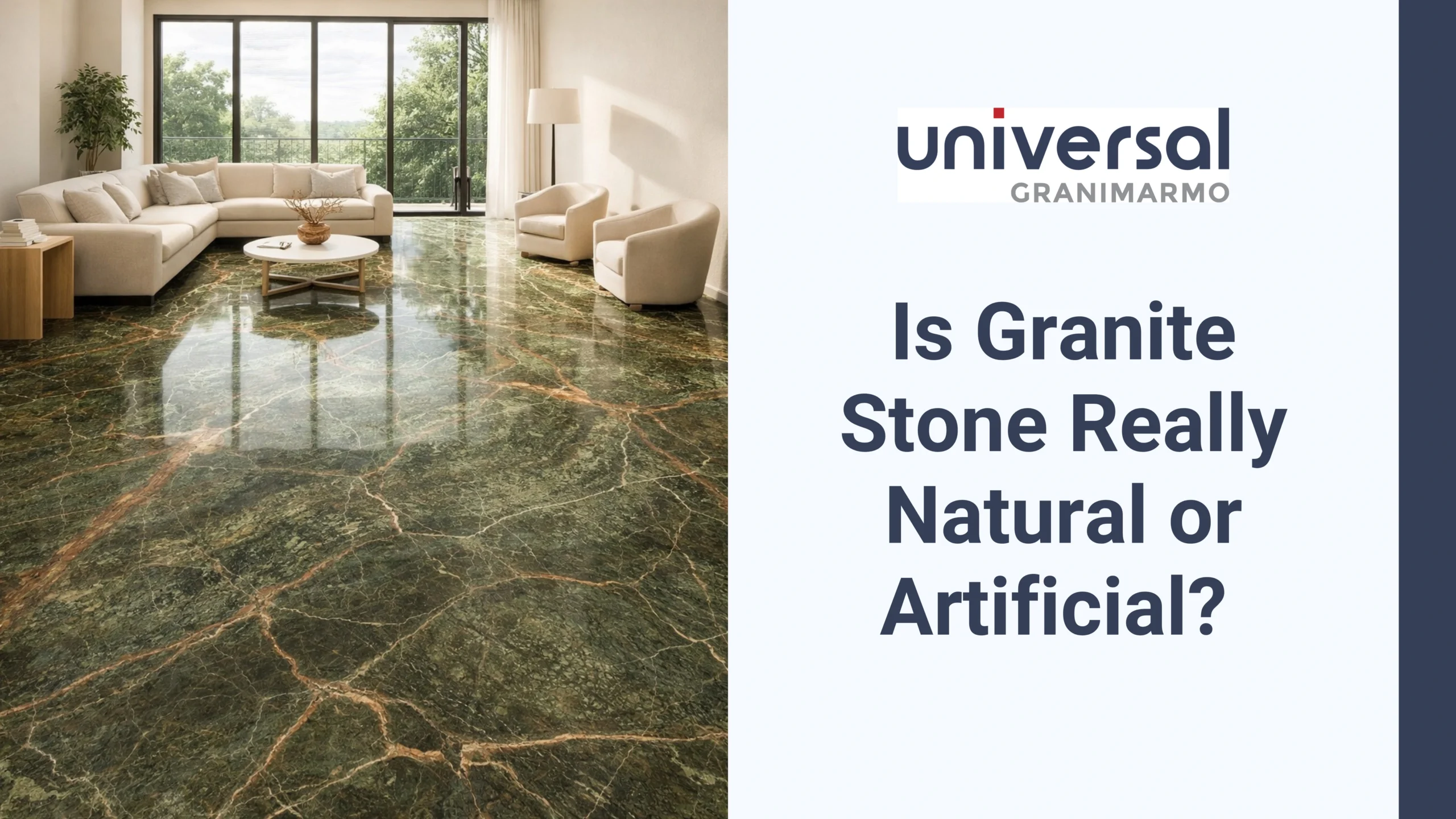
When people think about granite stone, they often picture strong kitchen countertops, shiny floors, or beautiful building exteriors. Granite is everywhere—from homes and offices to temples and monuments. But one common question still confuses many people:
The Origin of Granite
In its most basic form, granite is a naturally occurring stone that is formed deep within the ground. It is an igneous rock, which in the language of geology means that lava or magma cooled and solidified to make it. Large crystals can form as a result of the gradual cooling that occurs beneath the Earth’s surface over countless millennia, giving granite its distinctively granular texture. Quartz, feldspar, and mica are among the palette of minerals that are essential to the sculpting of granite; they all contribute to its color, toughness, and strength. There are granite deposits all throughout the world, from the colorful landscapes of Brazil to the mineral-rich regions of India. The granite in each of these locations has a distinct color.
The Development of Artificial Stones
The astute observer may wonder about the abundance of granite options on the market, some of which exhibit a uniformity and consistency of pattern that is not typical of natural stones. This discovery introduces us to the world of engineered stone, a man-made substance that, because of its similarities in look and characteristics to natural granite, is frequently discussed in the same contexts. Engineered stone, sometimes known as quartz in the industry, is created by mixing a mixture of resins, pigments, and other elements with about 90% real quartz crystals. After that, the mixture is molded and put through a vibro-compression vacuuming process, which produces slabs with a look similar to granite but with a distinct set of useful characteristics, such as non-porosity and a more consistent appearance. Check out this blog post from ours to learn more about the distinctions between quartz and granite.
Why choose natural stone?
Natural stone plays an irreplaceable role in modern design with its naturally formed colors, textures, and forms. Unlike artificial stone, natural stone has:
Unique beauty: each stone has a natural texture that cannot be copied.
Durable quality: it can maintain its luster and stability over the years.
Sustainable and environmentally friendly properties: it comes from nature, returns to nature, and is environmentally friendly.
Processing Granite Does Not Make It Artificial
After mining, granite goes through several steps:
- Cutting – Blocks are sliced into slabs or tiles
- Polishing – Surface is polished for shine
- Finishing – Edges are shaped (straight, bevel, bullnose, etc.)
- Quality Check – Cracks and defects are inspected
These steps only change the shape and surface, not the nature of the stone.
Just like cutting a diamond doesn’t make it artificial, cutting granite doesn’t change its natural origin.
Is Granite Safe for Homes?
Yes, granite is completely safe.
Since granite is natural:
- It does not release harmful chemicals
- It does not contain plastic or synthetic binders
- It is safe for kitchens and food preparation
With proper sealing, granite is also resistant to stains and moisture.
Conclusion
Granite stone is a gift from nature. Its journey starts deep inside the Earth and ends in our homes as floors, countertops, and beautiful surfaces. While modern tools help shape it, granite itself remains completely natural.
Understanding this difference helps you make better decisions when choosing stone for your home or project. When you choose granite, you are choosing something real, timeless, and naturally strong.