
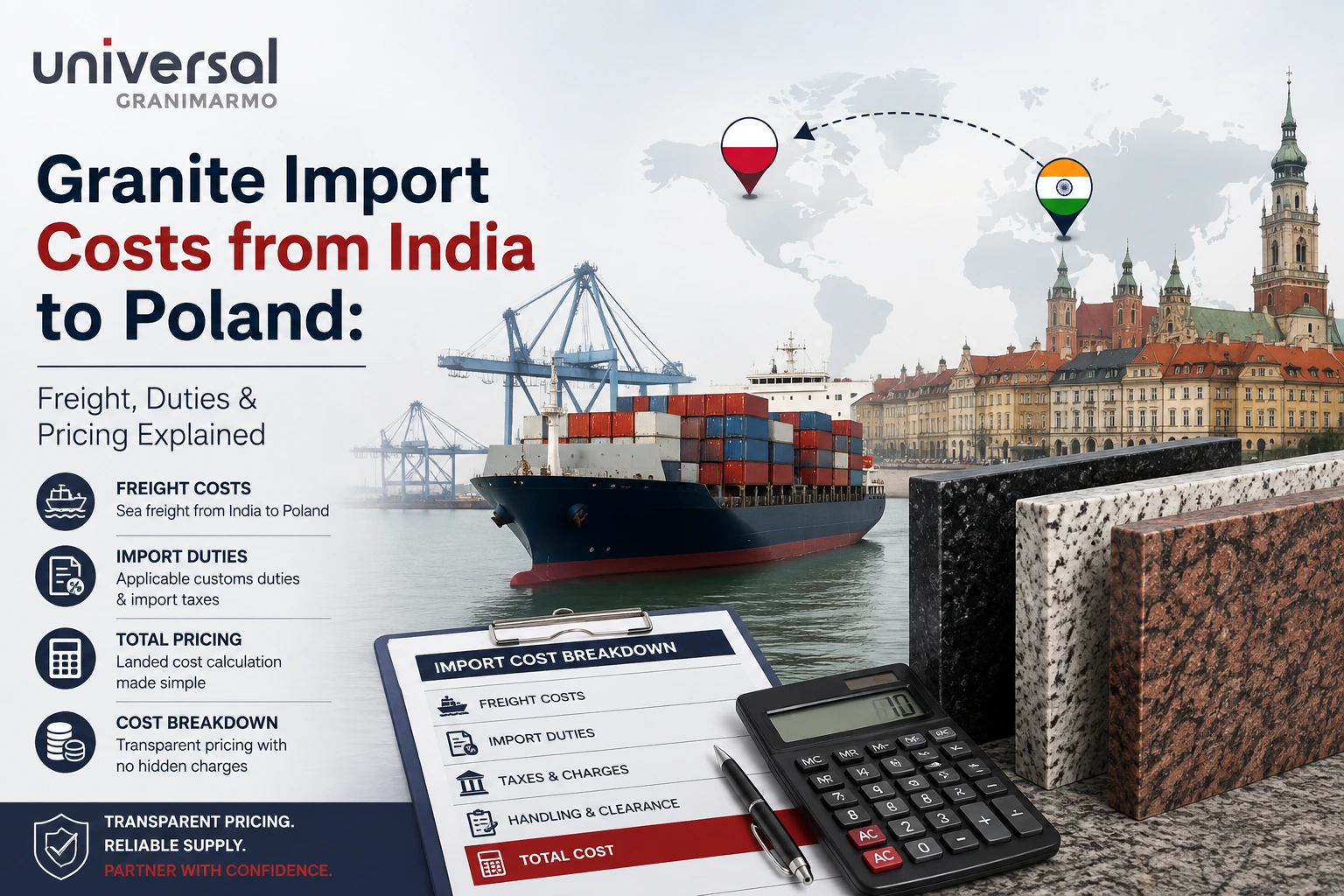
Poland’s construction and interior design boom has pushed more importers, fabricators, and distributors to source granite directly from India. The appeal is obvious — better slab quality, a wider colour range, and factory-direct pricing. But the number that actually decides whether a deal makes sense isn’t the ex-factory price per square metre; it’s the landed cost — what the granite costs once it clears customs and reaches your warehouse in Poland.
This guide breaks down every cost layer involved in importing granite from India to Poland, so you can build an accurate budget before you place your first order.
1. Ex-Factory Price (India)
This is the starting point — the price quoted by the Indian exporter for the granite itself, based on:
- Stone type and colour (e.g., Black Galaxy, Steel Grey, Tan Brown, Kashmir White)
- Finish (polished, flamed, honed, leathered)
- Slab thickness (typically 2 cm or 3 cm)
- Order volume (bulk orders reduce per-square-metre cost significantly)
- Gangsaw vs. block-cutter processing
Reputable exporters quote this as an FOB (Free on Board) price at an Indian port such as Chennai, Kandla, or Mundra — meaning the exporter’s responsibility ends once the container is loaded onto the vessel.
2. Ocean Freight (India to Poland)
Since Poland has no direct deep-sea port connection from India, granite typically travels via:
- Sea route: Chennai/Mundra/Kandla → transhipment hub (e.g., Colombo, Jebel Ali, or Rotterdam/Hamburg) → Gdańsk or Gdynia, or inland via a Western European port with onward rail/truck transport to Poland.
- Transit time: Roughly 30–45 days door-to-door, depending on the transhipment route and season.
Freight is usually quoted per container:
- 20ft container: Holds roughly 18–20 tonnes of granite slabs (fewer slabs than a 40ft due to weight limits, since granite is dense).
- 40ft container: Holds more slab area but is often weight-capped rather than volume-capped for granite specifically.
Freight rates fluctuate with fuel surcharges, container availability, and seasonal demand, so always get a current quote rather than relying on last year’s numbers.
3. Customs Duty in the EU
Granite falls under HS Chapter 68 (worked monumental or building stone), with the exact subheading depending on processing:
- 6802 91 (simply cut/sawn granite)
- 6802 93 (further worked — polished, profiled, or shaped granite)
The EU applies its Common Customs Tariff (MFN rate) unless a preferential scheme applies. For most granite tariff lines from India, published EU duty rates for worked/polished granite are commonly cited in the low single digits (frequently in the 0–3% range), though the exact rate depends on the specific 8–10 digit CN/TARIC code, the degree of processing, and whether any preferential scheme applies at the time of import.
Important: Duty schedules and preference schemes change periodically, and correct classification is what determines your actual rate. Always have your customs broker confirm the precise TARIC code and duty rate at the time of shipment — misclassification is one of the most common (and costly) mistakes importers make.
4. Import VAT
Once goods clear customs into Poland, Polish import VAT applies to the total customs value (goods value + freight + insurance + duty). Poland’s standard VAT rate is 23%. VAT-registered businesses can typically reclaim this as input VAT, so it’s a cash-flow consideration rather than a permanent cost for most commercial importers — but it still needs to be budgeted for at the time of import.
5. Marine Insurance
Cargo insurance typically costs a small percentage of the shipment’s insured value (commonly a fraction of a percent to around 1–2%, depending on the insurer and coverage level). Given that a single container of granite can represent a significant investment, insurance is not an area to skip — cracked or chipped slabs from rough handling are a real risk over a 30–45 day voyage.
6. Port, Handling & Inland Logistics (Poland side)
After the container reaches a port (Gdańsk/Gdynia, or a Western European hub with onward transport), additional costs include:
- Terminal handling charges (THC)
- Customs clearance/brokerage fees
- Inland trucking or rail to your warehouse or fabrication facility
- Unloading and storage fees if the container isn’t cleared promptly
These “last mile” costs are often underestimated but can add a noticeable percentage to the total landed cost, especially for buyers located farther from the coast (e.g., southern Poland).
7. Putting It Together: A Simplified Landed Cost Formula
Landed Cost = FOB Price (India)
            + Ocean Freight
            + Marine Insurance
            + Customs Duty (on FOB + Freight + Insurance)
            + Import VAT (on Customs Value + Duty)
            + Port/Terminal Handling
            + Inland Transport to Final Destination
            + Customs Brokerage Fees
Every shipment’s numbers will differ, but this structure lets you build a realistic cost sheet before committing to an order — and compare it fairly against buying from a European or Turkish supplier.
8. How Buying in Bulk Changes the Math
Freight, port charges, and brokerage fees are largely fixed per container, regardless of how much granite is inside. This means:
- A full container load (FCL) dramatically reduces the freight-per-square-metre cost compared to smaller shipments.
- Consolidating multiple colours/finishes in one container (where the exporter allows it) can help smaller buyers still hit efficient container utilisation.
- Buyers who commit to recurring, scheduled shipments often negotiate better ex-factory pricing and more predictable freight slots.
9. Tips to Keep Import Costs Under Control
- Work with an experienced Indian exporter who ships regularly to the EU and understands Polish customs documentation requirements.
- Confirm Incoterms clearly (FOB, CIF, or DAP) so there’s no ambiguity about who pays for freight, insurance, and customs clearance.
- Get your HS/TARIC classification verified by a licensed customs broker before shipping, not after.
- Request a detailed packing list and proforma invoice in advance — errors here cause customs delays that add storage costs.
- Ask about crating standards — granite slabs damaged in transit erode any cost savings from a lower ex-factory price.
Frequently Asked Questions
1. Is it cheaper to import granite from India than to buy from a local Polish or European supplier?
Often yes, especially for premium colours not quarried in Europe, and for bulk orders where the freight cost per square metre drops significantly. However, the savings depend heavily on shipment size, current freight rates, and your location within Poland relative to the port. It’s worth building a full landed-cost comparison rather than comparing ex-factory prices alone.
2. What documents do I need to import granite from India into Poland?
Typically, a commercial invoice, packing list, bill of lading, certificate of origin, and any required phytosanitary or quality certificates. Your customs broker or freight forwarder can confirm the exact documentation needed for your specific HS code and shipment.
3. How long does shipping granite from India to Poland take?
Most shipments take approximately 30–45 days door-to-door, depending on the transhipment route, port congestion, and season. Always build in buffer time for project planning.
4. What Incoterm should I choose — FOB, CIF, or DAP?
FOB gives the buyer more control (and responsibility) over freight and insurance, which suits buyers with an established freight forwarder relationship. CIF or DAP shifts more logistics responsibility to the exporter, which can be simpler for first-time importers but may cost slightly more. Discuss with your supplier which option fits your experience level and budget.
5. Do I need a customs broker in Poland?
While not always legally mandatory, using a licensed customs broker is strongly recommended. Correct HS/TARIC classification directly affects your duty rate, and errors can cause costly delays or reassessments.
6. Are there any preferential duty schemes that reduce the tariff on Indian granite?
Preferential trade schemes and duty rates change periodically and depend on the specific product classification. Always verify the current applicable rate with your customs broker or the EU’s official TARIC database at the time of shipment rather than relying on older figures.
7. What’s the minimum order quantity that makes importing cost-effective?
There’s no fixed number, but because freight and port charges are largely fixed per container, most buyers find that ordering close to a full container load (FCL) — rather than a small partial shipment — delivers the best cost efficiency.
8. How can I avoid damaged slabs during the long sea transit?
Confirm the exporter uses proper wooden A-frame or L-frame crating designed for granite slabs, ask about padding and securing methods, and always insure the shipment. Reviewing photos or videos of the exporter’s packing process before shipment is a good practice.
Looking for a reliable granite exporter with export experience to the European market? Universal Granimarmo has been supplying granite, marble, sandstone, and limestone from India since 2013, with dedicated support for bulk orders and international shipping documentation. Get in touch for a custom quote.