
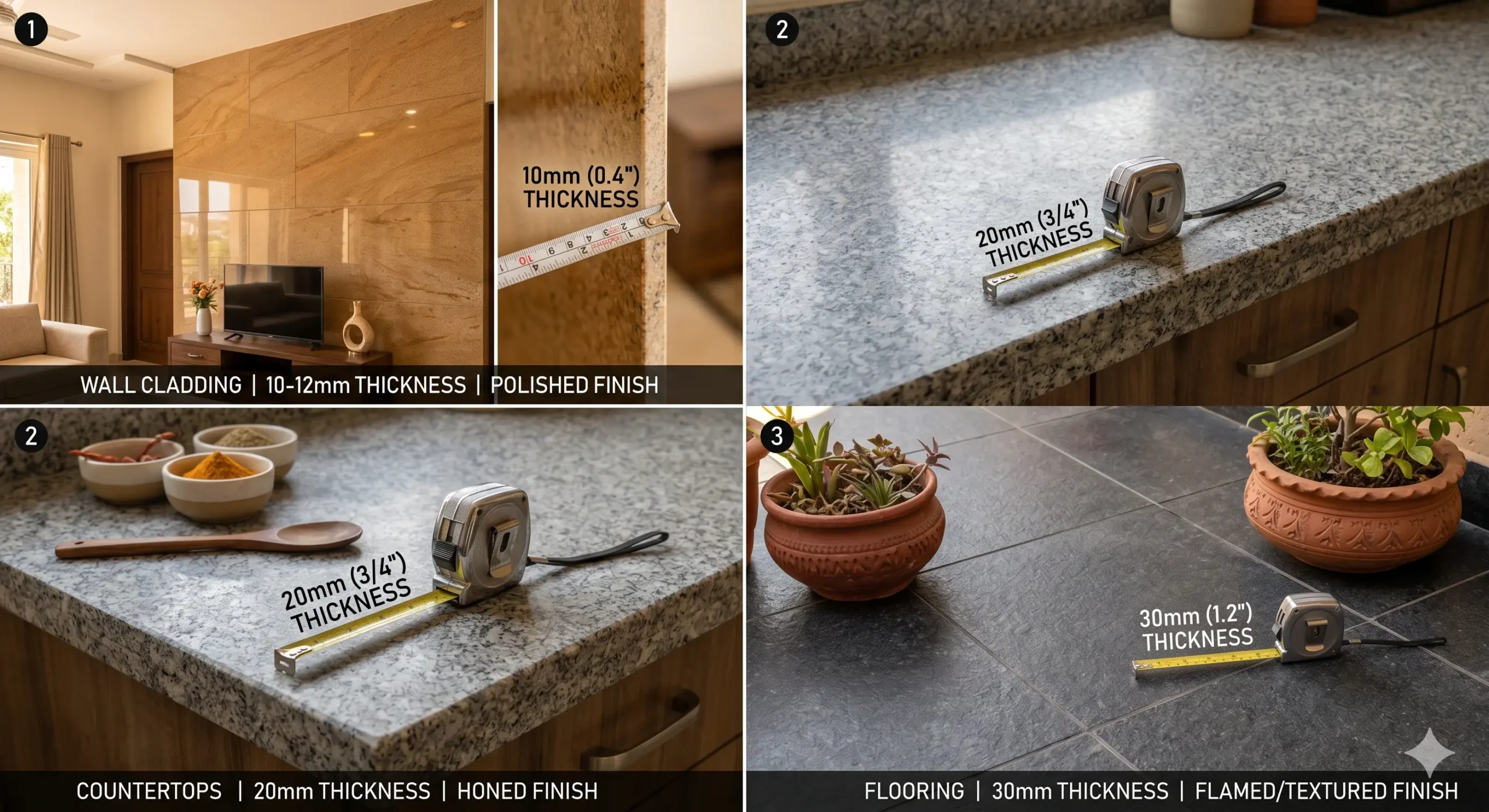
You’ve chosen granite. Smart decision. But choosing the stone is only half the job — choosing the right thickness and the right finish for your specific application is what separates a successful installation from an expensive mistake.
A 10mm wall cladding panel used on a kitchen countertop will crack. A 30mm polished slab installed on a damp outdoor terrace becomes a safety hazard. A flamed finish in a luxury hotel lobby looks completely out of place. Every combination of thickness and finish exists for a reason — and knowing which one fits your project is the knowledge that professionals rely on.
At Universal Granimarmo, we manufacture and export granite tiles, slabs, and custom-cut pieces across five production units in Rajasthan and South India. Every day, our team advises architects, contractors, and importers on exactly this question: What thickness? What finish?
Granite Thickness — What the Numbers Mean
Granite thickness is measured in millimetres (mm) or centimetres (cm). The most common commercial options range from 10mm to 30mm, with specific thicknesses suited to specific applications.
Here is a complete reference guide:
| Thickness | Common Name | Primary Applications |
| 10mm | Thin tile / veneer | Interior wall cladding, backsplashes, decorative panels |
| 12mm | Standard wall tile | Premium countertops, heavy-traffic commercial floors, and external facades |
| 16mm | Medium tile | Residential flooring (low traffic), wall cladding |
| 18mm | Standard floor tile | Residential and light commercial flooring, bathroom floors |
| 20mm (2cm) | Standard slab | Countertops (with backing), commercial flooring, stair treads |
| 30mm (3cm) | Thick slab | Premium countertops, heavy-traffic commercial floors, external facades |
| 40mm+ | Custom / monumental | Interior walls, light decorative flooring, and restroom vanities |
The fundamental rule is straightforward: the more load-bearing and high-traffic the application, the thicker the granite needs to be.
Granite Thickness for Flooring
Flooring is where getting thickness wrong has the most immediate consequences — cracked tiles, uneven surfaces, or stone that simply doesn’t survive the foot traffic it was asked to handle.
Residential Flooring
For homes — living rooms, bedrooms, hallways, and kitchens — the industry standard is 16mm to 20mm (1.6cm to 2cm) granite tiles. This thickness:
- Provides adequate structural strength for normal foot traffic
- Is light enough for standard concrete substrates without reinforcement
- Works with common tile sizes: 60×60 cm, 60×30 cm, 60×90 cm
- Is the most cost-effective option for large floor areas
UGM recommendation for residential flooring: 18mm polished or honed tiles in 60×60 cm or 60×120 cm format. Polished for formal interiors; honed for contemporary or minimalist design.
Commercial Flooring
Airports, malls, hotel lobbies, hospitals, and office buildings demand more. For high-traffic commercial flooring, 20mm to 30mm is the professional standard.
- 20mm suits most commercial interiors with moderate traffic (offices, boutique hotels, restaurants)
- 30mm is specified for very high-traffic zones: airport check-in halls, metro stations, large shopping centres
The increased thickness reduces the risk of cracking under concentrated loads (trolleys, heavy equipment, constant foot traffic), and provides better acoustic dampening underfoot — a subtle but appreciated quality in luxury hospitality projects.
UGM recommendation for commercial flooring: 20mm Steel Grey or Absolute Black in 60×60 cm or 60×120 cm polished tiles. For open public spaces, a honed or brushed finish on the same thickness is preferable for safety.
Outdoor Flooring and Paving
Outdoor applications introduce new variables: thermal expansion, moisture, frost (in colder climates), and the absolute requirement for non-slip surfaces.
For garden paving, terraces, pool surrounds, and driveways, 20mm to 30mm flamed or brushed granite is the correct specification. Never use polished granite outdoors — it becomes dangerously slippery when wet.
UGM recommendation for outdoor paving: 20mm flamed or brushed Jalore Pink, Crystal Yellow, or Rajasthan Black in 60×40 cm or 60×60 cm format. These North Indian varieties are naturally robust for outdoor use, and their warm tones complement landscaped environments.
Granite Thickness for Countertops
Countertops are the most specification-sensitive application. They bear direct load, handle daily impact, are exposed to food, water, heat, and cleaning chemicals — and they must look perfect for decades.
The 20mm vs 30mm Countertop Debate
This is the most common question our export team receives from buyers in the UAE, USA, and Europe.
20mm (2cm) granite countertops:
- Lighter weight — easier to transport and install
- Requires plywood or MDF substrate for structural support
- Suitable for bathroom vanities, utility counters, laundry areas
- More affordable — approximately 20–25% lower material cost than 30mm
- Popular in commercial fit-outs where weight-loading is a concern (high-rise buildings)
- Commonly specified in European projects
30mm (3cm) granite countertops:
- Self-supporting — can overhang up to 30cm without substrate
- No backing required — cleaner installation
- Supports a wider range of edge profiles (bullnose, ogee, waterfall, bevelled)
- Provides a more substantial, luxurious visual presence
- The dominant standard in the USA and Gulf markets accounts for over 75% of residential kitchen countertops in North America
- Better suited for heavy-use kitchen environments: professional cooking, high daily use
UGM recommendation for kitchen countertops: 30mm Black Galaxy, Absolute Black, Kashmir White, or Tan Brown polished slabs. These South Indian varieties combine the required technical performance (low porosity, high compressive strength) with the mirror-finish quality that countertop applications demand.
For bathroom vanities: 20mm is entirely appropriate and reduces cost without compromising aesthetics.
Laminated Edge Countertops
A popular technique for the UAE and Indian luxury residential market: two 20mm slabs are joined at the edge with a precision epoxy bond to create the visual appearance of a 40mm countertop — at a lower weight and cost than a solid 40mm slab. UGM fabricates laminated-edge countertops for export to multiple Gulf projects.
Granite Thickness for Wall Cladding
Wall cladding is a vertical application, which changes the engineering calculus entirely. The stone is fixed to a backing structure — not load-bearing — so the priority shifts from compressive strength to weight management and adhesion performance.
Interior Wall Cladding
For interior wall panels, feature walls, elevator lobbies, reception areas, and bathroom walls, 10mm to 18mm granite is the standard specification.
- 10mm–12mm: Feature walls, decorative panels, backsplashes. Requires mesh or resin backing for structural integrity. Very lightweight, ideal for high-rise installations.
- 14mm–18mm: Main interior cladding panels. Self-supporting on proper anchor systems. The most common thickness for hotel lobbies, corporate headquarters, and luxury residential wall cladding.
Tile sizes for interior cladding: 60×30 cm, 60×60 cm, 60×120 cm. Larger formats (90×90 cm, 120×60 cm) create a dramatic, seamless effect but require precise anchor engineering.
UGM recommendation for interior cladding:
15mm or 18mm Fantasy Brown, Alaska White, or Steel Grey in honed or polished finish. For feature walls behind reception desks or in elevator interiors, 18mm Black Galaxy with a polished finish creates maximum visual impact.
Exterior Facade Cladding
External building facades face wind load, thermal cycling, moisture, UV exposure, and in coastal regions, salt air. This demands a minimum of 20mm to 30mm granite, properly anchored with a ventilated facade system.
For landmark projects — government buildings, corporate towers, hospitality facades — 30mm is the professional specification. UGM has supplied 30mm granite panels for exterior facade cladding on projects in Abu Dhabi, Sharjah, and Oman, where thermal expansion management and wind-load resistance are critical design considerations.
Finish for exterior facades:
Flamed, brushed, or sandblasted — never polished, as polished surfaces on facades create glare and become slippery on ledges and sills.
Granite Finishes — A Complete Guide
Thickness determines structural performance. Finish determines surface character — how the stone looks, feels, and behaves in daily use.
These are the seven most commercially significant granite finishes, with their applications explained honestly.
1. Polished Finish
What it is: The surface is ground progressively finer using abrasive pads, then buffed to a high-gloss, mirror-like reflectivity. It is the most common finish worldwide.
What it looks like: Mirror-smooth, highly reflective. Colours appear deepest and richest. Black Galaxy’s gold flecks become dramatically visible. Kashmir White’s grey and burgundy clusters pop against the white background.
Best for:
- Kitchen and bathroom countertops
- Interior flooring in dry areas
- Interior wall cladding and feature walls
- Elevator interiors, reception desks, luxury retail
Avoid for:
- Outdoor applications (slippery when wet)
- High-humidity wet areas without anti-slip treatment
- Rustic or industrial design aesthetics
Maintenance: Wipe clean easily. Seal once a year for countertops. Shows fingerprints and water spots more visibly — wipe regularly in commercial spaces.
Honed Finish
What it is: Polished to a smooth surface but stopped before the high-gloss stage is achieved. The result is a matte or satin surface — smooth to the touch but not reflective.
What it looks like: Soft, understated, contemporary. Colours appear slightly lighter and more muted than polished. The stone looks elegant without demanding attention.
Best for:
- Contemporary and minimalist interiors
- Bathroom floors and walls (more forgiving of water marks)
- Countertops where a non-glossy aesthetic is preferred
- Stair treads (safer than polished)
- Commercial interiors where glare reduction is required
Avoid for:
- Outdoor paving (less slip-resistant than flamed or brushed)
- High-stain-risk countertops (slightly more porous surface than polished)
Maintenance: Slightly more susceptible to staining than polished — seal more frequently (every 6–12 months for countertops). More forgiving of fingerprints and smudges.
Flamed (Thermal) Finish
What it is: The granite surface is exposed to a high-intensity acetylene or propane torch flame (temperatures exceeding 1,000°C), which causes the surface minerals to expand rapidly and spall — creating a rough, crystalline texture. The stone is then cooled rapidly with water.
What it looks like: Rough, textured, organic. Colours lighten noticeably — blacks become dark grey, reds become terracotta-like. The surface feels coarse and has a natural, earthy character.
Best for:
- Outdoor paving and pool surrounds (excellent slip resistance)
- Driveway and pathway tiles
- Exterior steps and stair treads
- Courtyard flooring, terrace paving
- Commercial outdoor plazas and civic landscaping
Avoid for:
- Kitchen countertops (very difficult to clean in crevices)
- Interior wall cladding (too rough for vertical surfaces)
- Any application where colour depth matters — flaming significantly lightens the stone
Maintenance: Low maintenance outdoors. Brush clean periodically. No sealing required for outdoor use.
Brushed (Antique / Satin) Finish
What it is: The surface is worked with hard metal or silicon carbide brushes that abrade the softer mineral components, leaving the harder crystals slightly raised. The result is a textured but smooth-to-touch surface, similar in feel to aged stone.
What it looks like: Warm, worn, tactile. Less rough than flamed but more textured than honed. Gives granite a naturally aged, artisanal appearance. Very popular in Rajasthan stone — Jalore Pink and Rajasthan Black with a brushed finish are widely used in heritage and transitional design projects.
Best for:
- Residential outdoor terraces and pool decking
- Feature flooring in transitional or heritage interior styles
- Bathroom floors (good slip resistance, softer appearance than flamed)
- Wall cladding in rustic or warm-contemporary designs
Avoid for:
- Formal commercial interiors where uniformity is required
- Kitchen countertops (slightly harder to clean than polished or honed)
Maintenance: Similar to honed — seal periodically. The texture hides minor marks well.
Sandblasted Finish
What it is: High-pressure compressed air carrying fine-grit sand or aluminium oxide is blasted against the granite surface. This creates a uniform, fine-grained matte texture — lighter than flamed, more even than brushed.
What it looks like: Soft, slightly rough, uniform. Colours lighten considerably. The surface has a fine, sandy texture that is pleasant to touch and subtle in appearance.
Best for:
- Decorative wall panels and signage
- Exterior cladding where a subtle texture is preferred
- Pool copings and feature elements in landscaping
- Areas requiring moderate slip resistance without the roughness of flaking
Avoid for:
- High-traffic flooring (less durable surface than flamed or polished)
Kitchen countertops
Leathered Finish
What it is: A diamond-tipped brush is run over the honed surface at high pressure, creating small ripples and undulations. The result is a soft sheen — more depth than honed but without the mirror reflectivity of polished.
What it looks like: Rich, textured, warm. Many designers describe it as the most “natural-looking” finish — stone as it might appear after centuries of gentle wear. It has a soft glow rather than a hard shine.
Best for:
- Bar tops and restaurant tables
- Bathroom countertops and vanities
- Fireplace surrounds
- Custom furniture tops
- Clients who want the warmth of natural texture with manageable maintenance
Maintenance: Excellent at hiding fingerprints and smudges. Slightly harder to deep-clean in texture pits. Seal as per honed.
Bush Hammered Finish
What it is: A mechanical bush hammer (a tool with multiple steel points) breaks the surface of the granite, creating deep pits and a very pronounced rough texture — the most aggressive mechanical finish available.
What it looks like: Very rough, deeply textured, with a time-worn, almost primitive appearance. Strongest visual contrast of all finishes.
Best for:
- Exterior steps and access ramps (maximum slip resistance)
- Heavy-duty outdoor flooring in civic projects
- Retaining walls and exterior boundary elements
Swimming pool surrounds
The Master Reference Table
| Application | Recommended Thickness | Recommended Finish |
| Kitchen countertop | 30mm | Polished or Leathered |
| Outdoor terrace/paving | 20mm | Polished or Honed |
| Bar top | 30mm | Leathered or Polished |
| Residential interior flooring | 18mm | Polished or Honed |
| Commercial interior flooring | 20–30mm | Polished or Honed |
| Feature wall/reception | 20–30mm | Flamed or Brushed |
| Pool surrounds | 20mm | Flamed or Bush Hammered |
| Stair treads (interior) | 20–30mm | Honed |
| Stair treads (exterior) | 30mm | Flamed or Bush Hammered |
| Interior wall cladding | 12–18mm | Polished or Honed |
| Exterior facade cladding | 20–30mm | Flamed or Brushed |
| Backsplash | 10–12mm | Polished or Honed |
| Driveway/kerbstone | 18mm | Polished |
| Driveway / kerbstone | 30–40mm | Flamed |
| Monumental / memorial | 30–40mm | Bathroom countertop/vanity |
Frequently Asked Questions
Q: What is the most popular granite thickness for kitchen countertops in the UAE?
30mm (3cm) polished granite is the standard for kitchen countertops in UAE residential and hospitality projects. The Gulf market strongly favours 3cm for its self-supporting strength and premium visual weight — particularly in villa kitchens where large island countertops are common.
Q: Can I use the same thickness for both flooring and countertops?
Yes. A 20mm slab can serve both applications, but for countertops a 30mm slab is strongly preferred — particularly for overhanging edges. Using 20mm for flooring and 30mm for countertops in the same project is entirely standard practice.
Q: Which finish is best for a kitchen countertop that sees heavy daily use?
Polished is the practical winner for high-use kitchen countertops — it is the easiest to clean, the most stain-resistant (when sealed), and the most hygienic. Leather is a good alternative for those who want texture without sacrificing too much maintainability.
Q: Is polished granite safe for bathroom floors?
Polished granite on bathroom floors requires caution — it becomes slippery when wet. A honed or brushed finish is a much safer choice for wet bathroom floors. For bathroom walls, polished is perfectly appropriate and looks beautiful.
Q: Does the finish affect the price of granite?
Yes. Polished finish is the baseline price. Honed is generally 5–10% more expensive. Flamed and brushed add 10–20% to the base price due to additional processing time. Leathered and bush-hammered are also priced above polished, depending on the variety.
Q: What granite varieties does UGM supply in flamed finish?
UGM supplies flamed finish in Jalore Pink, Crystal Yellow, Rajasthan Black, Absolute Black, Steel Grey, and several sandstone varieties. Contact our export team for current availability and pricing.
Conclusion
Getting granite thickness and finish right is not complicated — but it does require matching specification to application, not choosing by aesthetics alone.
- Use 30mm polished for countertops. Always.
- Use 18–20mm polished or honed for interior flooring.
- Use 20–30mm flamed or brushed for anything outdoors.
- Use 10–18mm polished or honed for wall cladding.
The finish changes how stone feels and performs in use. The thickness determines whether it survives the application it was specified for.
At Universal Granimarmo, we manufacture granite across the full thickness and finish range — from 10mm decorative wall panels to 40mm custom kerbstones — from our facilities in Rajasthan and South India. Every piece is checked against our quality standards before it leaves the factory.
If you have a project specification and need help confirming the right thickness and finish, contact our export team — we’ll advise and quote within 24 hours.