
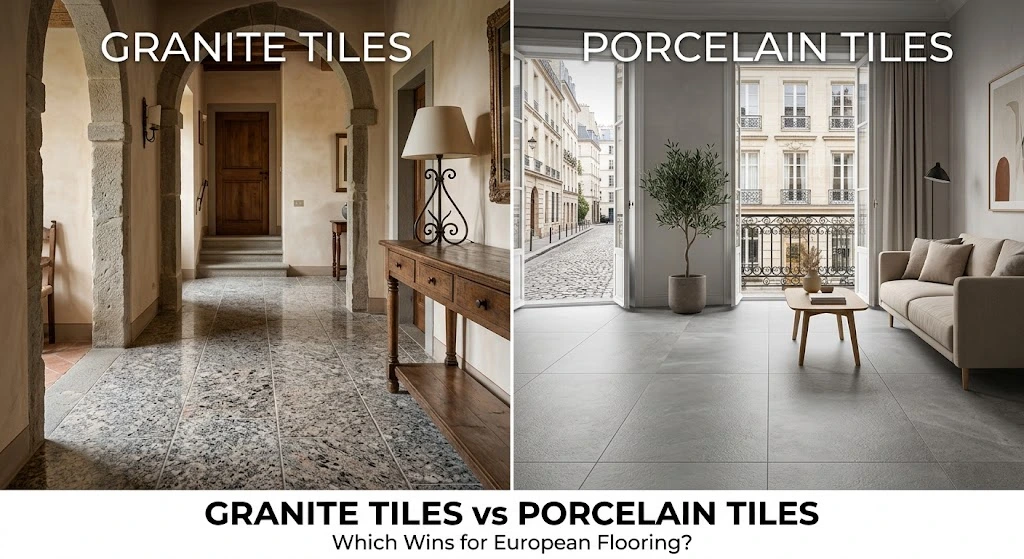
Granite tiles and porcelain tiles are the two most common choices for European flooring, and both have genuine strengths — there’s no single winner for every room. Granite is a natural stone with no two tiles exactly alike; porcelain is a manufactured ceramic, fired for uniformity and consistency. The right choice usually comes down to budget, the specific room, and how much variation in pattern you actually want. This guide compares them honestly, including where porcelain has the edge, so you can decide based on your project rather than a sales pitch.
Composition: Natural Stone vs Manufactured Ceramic
Granite tiles are cut from quarried stone blocks — an igneous rock formed from cooled magma over millions of years, scoring roughly 6–7 on the Mohs hardness scale. Every slab carries natural mineral variation, which is exactly what gives granite its depth and individuality, but also means no two tiles are perfectly identical.
Porcelain tiles are manufactured from refined clay fired at very high temperatures, which makes them denser and more water-resistant than standard ceramic tile, and gives manufacturers precise control over colour, pattern, and thickness. Porcelain can also be printed to mimic the look of granite or marble, which is part of why it’s become such a popular budget-conscious alternative across Europe.
Durability & Scratch Resistance
Granite holds a genuine advantage here for high-impact durability. Its natural hardness makes it highly resistant to scratching and chipping under heavy point-loads — dropped pans, furniture legs, foot traffic — which is why it’s long been favoured for kitchens and commercial floors.
Porcelain is also genuinely tough and benefits from consistent factory-controlled strength, since manufacturing removes the natural fault lines that can occasionally occur in quarried stone. Porcelain’s main vulnerability is impact chipping at tile edges and corners, particularly with large-format tiles, whereas granite’s strength is more uniform across the full tile.
| Granite Tiles | Porcelain Tiles | |
| Hardness | Naturally very hard (6–7 Mohs) | Hard, but manufactured strength |
| Scratch resistance | Excellent | Very good |
| Chip resistance | Strong across the surface | Strong, but edges can chip |
| Consistency | Varies naturally from batch to batch | Highly uniform |
| Lifespan with care | Often decades, sometimes a lifetime | Long-lasting, typically decades |
Cost Comparison (Per Square Metre, EU Market)
Porcelain tile is generally the more budget-friendly option upfront. Standard porcelain tiles in Europe typically run lower per square metre than natural granite, with premium large-format or designer porcelain ranges narrowing that gap considerably.
Granite tiles cost more upfront — landed prices for Indian granite tiles in Europe typically range from roughly €25–€45/m² for common colours up to €60–€120/m² for rarer or premium varieties, before installation. However, because granite rarely needs replacing and resists wear better over decades of heavy use, the lifetime cost gap between the two materials is often smaller than the upfront price difference suggests, especially in high-traffic areas where porcelain may need eventual replacement.
Maintenance
Porcelain is the lower-maintenance option day to day. It doesn’t require sealing, resists staining well due to its low porosity, and cleans easily with standard household products.
Granite needs periodic sealing — typically every 1–2 years for interior floors — to maintain its stain resistance, and benefits from pH-neutral cleaners rather than acidic products like vinegar, which can dull its polished surface over time. This is a genuine ongoing commitment, though a modest one once it’s part of a regular cleaning routine.
Which Rooms Suit Which Material
Kitchens generally favour granite for its heat and scratch resistance near cooking zones, though high-quality porcelain is a perfectly reasonable budget alternative.
Bathrooms work well with either, though a honed or textured finish is recommended for both materials to manage slip risk on wet floors — high-polish granite or glossy porcelain can both become slippery when wet.
Hallways and high-traffic areas benefit from granite’s resilience to scuffing and heavy footfall over many years, though large-format porcelain handles high traffic well, too.
Living rooms and bedrooms, where comfort and design flexibility matter more than extreme durability, are well-suited to either material, often coming down to budget and the desired look.
Outdoor patios and terraces need a slip-rated finish, either flamed or leathered granite, or textured outdoor-rated porcelain — and granite’s frost resistance, when properly sealed, makes it a strong option for colder European climates.
Underfloor Heating
Both materials work well with underfloor heating systems, which are increasingly common in European new-builds and renovations. Granite’s higher density means it tends to retain and radiate heat slightly longer once warmed, while porcelain heats up a little faster due to its typically thinner, more uniform structure. In practice, the difference is marginal enough that it shouldn’t be the deciding factor on its own.
So, Which Actually Wins?
Neither material “wins” outright — they win in different scenarios. Choose porcelain if budget predictability, design consistency, and lower day-to-day maintenance are the priority. Choose granite if you want a natural, one-of-a-kind material with genuine long-term durability in high-wear areas like kitchens, and you’re comfortable with the modest upkeep of periodic sealing. Many European homeowners use both — granite in heavy-use zones like the kitchen, and porcelain elsewhere — which is a practical way to balance cost and performance across a whole home.
Frequently Asked Questions
Is granite more expensive than porcelain tile?
Generally, yes, upfront, but granite tends to outlast porcelain with proper care and rarely needs replacement, which narrows the lifetime cost gap considerably in high-traffic areas.
Does granite tile crack more easily than porcelain?
Granite is naturally tougher under point impact, but porcelain has more consistent factory-controlled strength; both perform well when installed correctly, and the chipping risk for porcelain is mainly at tile edges.
Which is better for underfloor heating?
Both conduct heat well; granite holds heat slightly longer due to its higher density, while porcelain warms up marginally faster.
Does granite need sealing, and porcelain doesn’t?
Yes — granite is porous enough to need periodic sealing (typically every 1–2 years for interior floors) to resist stains, while porcelain’s low porosity means it generally doesn’t require sealing.
Can porcelain tile look like real granite?
Modern printing techniques allow porcelain to closely mimic granite’s appearance, though it won’t replicate the natural depth, subtle variation, and tactile texture of genuine quarried stone.
Which is better for resale value, granite or porcelain flooring?
Natural stone, including granite, is often perceived as a premium material in many European markets, which can support resale value, though high-quality porcelain is also well regarded, particularly in contemporary interiors.