
When you run your hand across a polished granite countertop or walk across a gleaming granite floor, it is easy to forget that what you are touching was once a rough, heavy block buried deep in the earth. The journey from a granite quarry to a finished, polished slab is a fascinating blend of geology, heavy engineering, skilled craftsmanship, and precision technology.
At Universal Granimarmo Pvt. Ltd. — India’s trusted granite supplier since 2013 — we oversee every stage of this process across our five manufacturing units in Ajitgarh, Ongole, Jalore, Karimnagar, and Jaipur. This guide gives you a transparent, expert-led look at exactly how granite slabs are made.
The 7-Step Granite Manufacturing Process
Geological Survey & Quarry Site Selection
Before any stone is extracted, geologists and quarry experts conduct detailed surveys to locate granite deposits with the right mineral composition, color consistency, and structural integrity. In India, prime granite regions include Jalore and Ajitgarh in Rajasthan (known for pink and grey granite), Karimnagar and Ongole in Telangana and Andhra Pradesh (home to famous Black Galaxy granite), and parts of Karnataka and Tamil Nadu. The quality of a finished slab is largely determined at this stage — the geological formation dictates the grain pattern, color, and durability of the final product.
Quarry Extraction — Blasting & Wire Sawing
Once a suitable deposit is identified, extraction begins. There are two main methods. Controlled blasting uses carefully placed explosive charges to fracture the granite along natural fault lines, minimizing wastage. Diamond wire sawing is the preferred modern method — a continuous wire embedded with industrial diamonds is run through the rock to cut clean, precise blocks. This method preserves more usable material and produces blocks with straighter edges. Typical quarry blocks weigh between 10 to 25 metric tonnes each.
Block Trimming, Inspection & Transport
Extracted blocks are rough-trimmed on-site using angle grinders and cutting machines to remove uneven edges. Each block is visually inspected for cracks, voids, or structural weaknesses. Blocks that pass inspection are loaded onto heavy-duty trucks or cranes for transport to the processing factory. For UGM, this means blocks from quarries near Jalore are transported to our Jalore factory, and Karimnagar-region blocks go to our Karimnagar unit — keeping logistics efficient and turnaround fast.
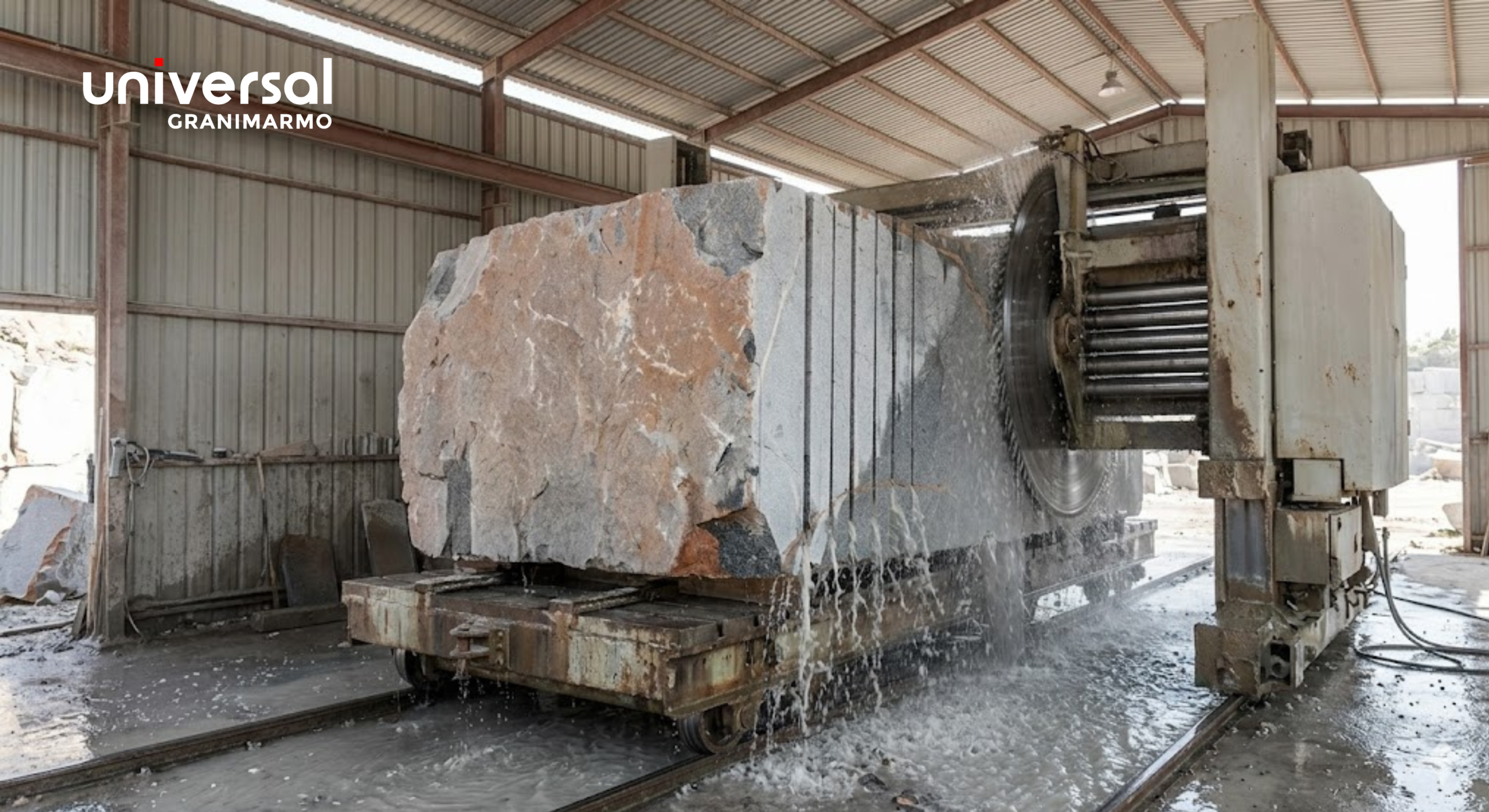
Gang Sawing — Cutting Blocks into Rough Slabs
At the factory, the granite block is loaded onto a gang saw — a machine fitted with multiple parallel diamond-tipped blades or a slurry of steel shot and water. The gang saws the entire block simultaneously into multiple slabs, typically 18mm, 20mm, or 30mm thick, depending on end use. This is one of the most time-intensive steps, often taking 12 to 36 hours per block. The resulting rough slabs are then washed and stacked for the next stage.
Grinding, Honing & Polishing
This is where raw stone becomes beautiful. Each slab passes through a polishing line — a series of abrasive heads with progressively finer grits (from coarse 36-grit to ultra-fine 3000-grit). The finish applied determines the final look: • Polished Finish — mirror-like, reflective surface; ideal for countertops and interior floors. • Honed Finish — smooth but matte; suited for bathrooms and low-traffic areas. • Flamed Finish — rough, non-slip texture created by exposing the surface to intense heat; used for outdoor paving. • Brushed / Antique Finish — aged, textured look; popular in landscaping and exterior cladding. At our Ongole factory, this process is where Black Galaxy granite develops its iconic sparkling surface — a combination of the natural mineral composition and precision polishing.
Quality Inspection, Grading & Thickness Calibration
Every slab undergoes multi-point quality checks before it leaves the polishing line. Inspectors check for: surface uniformity and color consistency, presence of natural fissures or micro-cracks, edge straightness and thickness tolerance (within ±1mm), and finish quality. Slabs are graded as First Quality, Commercial Quality, or Economy based on these checks. Thickness calibration machines then plane the underside of each slab to ensure perfectly uniform thickness — critical for installation flatness. At UGM, this step is non-negotiable across all five units, ensuring consistent quality for domestic and export orders.
Cutting to Size, Bundling & Export Packaging
Once graded, Granite slabs are cut to customer-specified dimensions using bridge saws or CNC cutting machines. Standard slab sizes are typically 240cm x 120cm or 260cm x 160cm, but custom sizes are cut for specific projects. Finished slabs are bundled in A-frames (metal or wooden cradles) and wrapped in protective foam and stretch film. Export consignments are additionally containerized in wooden crates for sea freight. UGM ships to the USA, UAE, Oman, Qatar, Turkey, and across Europe — all packed at our factories to international export standards.
Where UGM Makes Its Granite — Our 5 Production Units
Universal Granimarmo’s manufacturing strength comes from having multiple strategically located units, each positioned close to India’s best granite quarries:
| Unit | Speciality | Key Granite Types |
| Ajitgarh, Rajasthan | Precision cutting & polishing | Pink, White, Grey Granite |
| Ongole, Andhra Pradesh | Black Galaxy granite processing | Black Galaxy, South Indian Black |
| Jalore, Rajasthan | High-volume slab production | Pink, Multi-colour, White Granite |
| Karimnagar, Telangana | Raw block to polished slab | Tan Brown, Steel Grey, Colonial White |
| Jaipur, Rajasthan | Quartz & export operations hub | Engineered Quartz, Premium Marble |
Why the Manufacturing Process Matters When Choosing a Supplier
Not all granite suppliers control their own manufacturing. Many trading companies buy slabs from third-party factories, which means less visibility into quality standards and production consistency. At Universal Granimarmo, we own and operate all five of our production units, which gives us:
- Direct control over raw material sourcing from quarries
- In-house quality inspection at every stage
- Ability to custom-cut to specification for large international projects
- Faster turnaround and consistent batch quality
- Full traceability from quarry to dispatch
This integrated model is why institutions like the Presidential Palace of Abu Dhabi, Sharjah Municipality, Government Municipality of Oman, and university projects in Oman have trusted UGM for their stone requirements.
Frequently Asked Questions
| Q: How long does it take to make a granite slab? A: The full process from quarry extraction to finished polished slab typically takes 5 to 10 days, depending on block size, factory workload, and the finish required. Gang sawing alone can take 12 to 36 hours per block. |
| Q: What is the standard thickness of a granite slab? A: The most common thicknesses are 18mm, 20mm, and 30mm. For kitchen countertops, 20mm and 30mm are standard. For flooring tiles, 18mm or custom thinner cuts are used. UGM can produce custom thicknesses based on project requirements. |
| Q: What makes Indian granite better than other countries’ granite? A: India is home to some of the world’s richest and most diverse granite deposits, particularly in Rajasthan, Andhra Pradesh, Telangana, Karnataka, and Tamil Nadu. Indian granite is known for its wide color variety, high hardness (6 to 7 on the Mohs scale), low porosity, and competitive pricing. India accounts for over 25% of global granite production. |
| Q: What is the difference between polished, honed, and flamed granite? A: Polished granite has a mirror-like reflective surface and is ideal for countertops and interior use. Honed granite has a smooth matte finish, better suited for bathrooms or where a subtle look is preferred. Flamed granite has a rough, textured surface created by heat treatment, making it slip-resistant and ideal for outdoor paving and landscaping. |
| Q: How does Universal Granimarmo ensure quality? A: UGM conducts multi-point quality checks at each of our five manufacturing units — covering surface consistency, slab thickness calibration (±1mm tolerance), crack inspection, finish quality, and grading. All export slabs are additionally inspected before packing to meet international standards. |
Conclusion
From the first geological survey to the final polished surface wrapped for export, making a granite slab is a technically demanding, multi-stage process that requires expertise, infrastructure, and precision at every step. Understanding this journey helps buyers, architects, and project managers make more informed decisions about quality and sourcing.
With over a decade of manufacturing experience, five production units across India, and a track record of delivering to prestigious international projects, Universal Granimarmo brings unmatched depth to every slab it produces.