
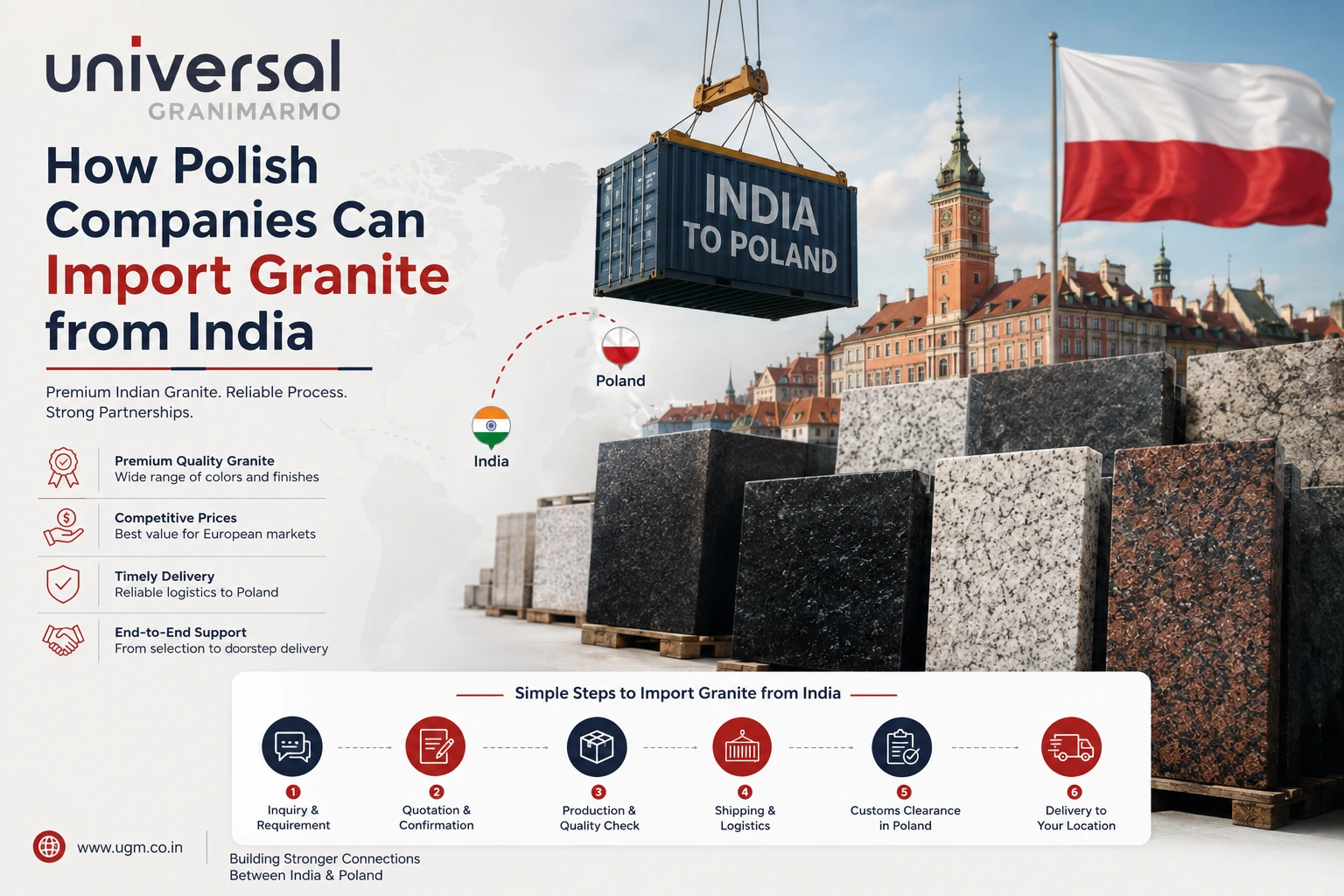
More Polish construction firms, worktop fabricators, and stone distributors are sourcing granite directly from India rather than buying through European middlemen. Done right, it can cut material costs significantly while opening access to colors and volumes that are hard to find locally. Here’s how Polish companies can approach the process — including what to look for from an established exporter like Universal Granimarmo.
Why More Polish Companies Are Sourcing from India
- Lower landed costs compared to European quarries, even after freight, duty, and VAT
- Greater color/pattern variety — India quarries hundreds of commercial granite types
- Flexible order volumes, from trial pallets to full container loads (FCL)
- Established EU trade lane — natural stone from India is a well-trodden import category, so the customs and logistics process is predictable once you know the steps
Step 1: Define What You Actually Need
Before contacting suppliers, nail down:
- Colors and finishes (polished, honed, flamed, leathered)
- Slab or tile dimensions, and thickness (commonly 2 cm or 3 cm)
- Quantity — trial order vs. ongoing supply contract
- End use — worktops, flooring, cladding, monuments — since this affects grading and tolerances
A clear spec avoids back-and-forth delays and lets suppliers quote accurately.
Step 2: Find and Vet Suppliers
Polish importers should shortlist suppliers based on:
- Export track record with EU/Polish clients — ask for references
- Direct quarry access vs. trading house — quarry owners/processors often give better pricing and consistency
- Certifications — ISO 9001 and, increasingly, sourcing/ethics certifications for public tenders
- Sample transparency — insist on photos or physical samples of the actual batch, not catalog stock images
- Communication quality — clear documentation and responsiveness are strong signals of professionalism
Major Indian granite sourcing belts include Tamil Nadu (Chennai region), Andhra Pradesh, Karnataka, and Rajasthan — suppliers near these regions and major export ports (Chennai, Kandla) typically offer shorter, more predictable logistics chains.
Universal Granimarmo (ugm.co.in) is one exporter Polish buyers can evaluate against this checklist — ask them directly for their current catalog, references from European clients, and sample availability.
Step 3: Get and Compare Quotes Properly
Don’t compare suppliers on FOB price alone. Ask each for:
- FOB and CIF pricing per m² or per ton, by grade
- Minimum order quantity
- Lead time from order confirmation to shipment
- Packing method (wooden crates should be ISPM-15 compliant for EU entry)
Then calculate total landed cost: FOB + ocean freight + insurance + EU customs duty + Polish VAT + inland transport. As a rule of thumb, these additions often add roughly 40–70% on top of the FOB price by the time material reaches a Polish warehouse.
Step 4: Understand the Customs & VAT Requirements
- Granite typically falls under CN 2515 (raw/roughly trimmed) or HS 6802 (worked/polished stone), with EU duty rates generally in the 0–10% range depending on exact classification — confirm the specific TARIC code with a customs broker before shipping.
- Polish VAT (23% standard rate) applies on customs value plus duty, generally recoverable as input VAT for registered businesses.
- There is currently no anti-dumping duty specifically on Indian granite, but trade measures can change, so it’s worth a quick check on large orders.
Step 5: Manage Shipping and Delivery
- Typical transit time from Indian ports to Poland (direct or via a major EU transshipment hub) is 4–6 weeks, plus 1–2 weeks for customs clearance and inland delivery.
- Arrange marine cargo insurance given the breakage risk with stone slabs.
- Use a Polish customs broker experienced with natural stone imports to avoid classification errors and delays.
- Consider a third-party pre-shipment inspection in India to catch cracks, color mismatches, or dimension errors before the container leaves port.
Common Mistakes Polish Importers Should Avoid
- Comparing suppliers on FOB price only, without calculating landed cost
- Skipping samples or pre-shipment inspection to save time
- Using non-ISPM-15 compliant wooden packaging, which can be rejected at EU customs
- Not confirming the exact TARIC code before finalizing pricing
- Underestimating total transit + customs time in project schedules
FAQs
1. Can a small or medium-sized Polish company import granite directly from India, or is it only viable for large firms?
Small and medium businesses can do it too. Many exporters, including Universal Granimarmo (ugm.co.in), accommodate smaller trial orders alongside full-container shipments — it’s worth asking suppliers directly about minimum order quantities.
2. What documents does a Polish company need for customs clearance?
Typically: commercial invoice, packing list, bill of lading, certificate of origin, and ISPM-15 compliance documentation for wooden packaging. A customs broker will handle the TARIC classification and duty/VAT payment.
3. How much cheaper is Indian granite compared to buying locally in Poland or the EU?
Landed cost (after freight, duty, and VAT) is often 30–50% lower than comparable European-sourced granite, though this varies by color, grade, and order volume.
4. Do I need a customs broker, or can I clear the shipment myself?
Technically, you can self-clear, but most Polish importers use a licensed customs broker familiar with natural stone HS/CN codes to avoid misclassification, which is one of the most common causes of import delays.
5. How do I know the granite I receive will match what I was quoted?
Request samples or photos from the actual production batch, and consider a third-party pre-shipment inspection before the container is loaded — this is standard practice for first-time importers.
6. What’s the biggest risk when importing granite from India for the first time?
Underestimating total landed cost and lead time. First orders should include a buffer for customs delays and should be based on total cost calculations, not just FOB quotes.