
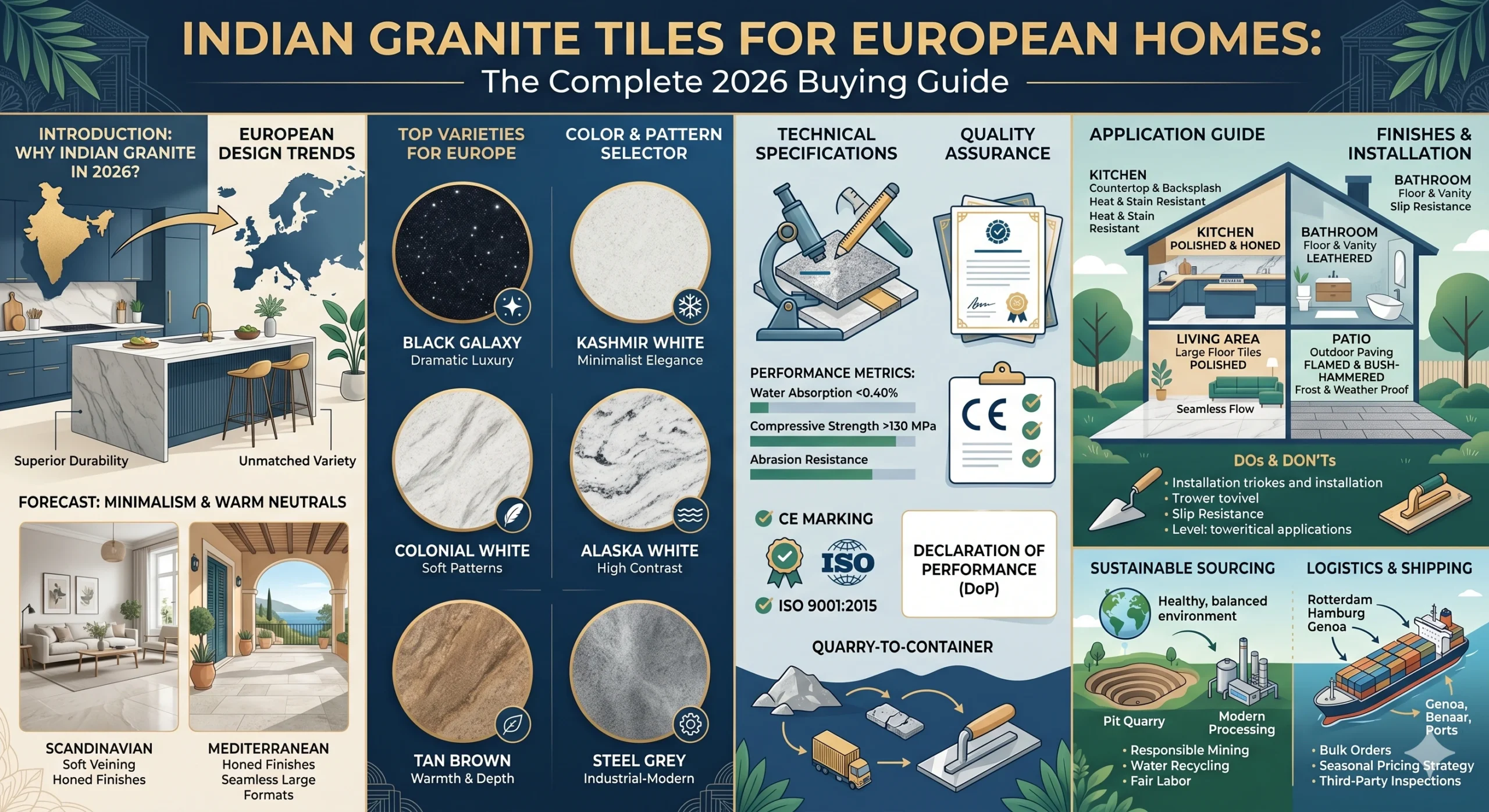
India supplies more granite to the world than almost any other country, and a growing share of it now ends up in homes across Germany, the UK, France, Italy, and the Netherlands. If you’re considering Indian granite tiles for a European home or renovation project, this guide covers what actually matters: how Indian granite differs from European stone, the main colour families available, how tiles are quarried and quality-checked, what’s involved in importing them, and how to choose a supplier you can trust.
What Makes Indian Granite Different From European or Brazilian Granite
Granite is granite, geologically speaking — it’s an igneous rock formed from slowly cooled magma, and it scores roughly 6–7 on the Mohs hardness scale regardless of where it’s quarried. What actually differs between Indian, European, and Brazilian granite is availability, colour range, and price.
India has one of the largest and most geologically diverse granite reserves in the world, spread across states like Rajasthan, Andhra Pradesh, Telangana, and Karnataka. This gives Indian quarries access to colour and pattern variety that’s harder to find in smaller European deposits — from deep blacks and warm browns to rare blues and golds. Labour and quarrying costs in India are also generally lower than in Italy, Spain, or Scandinavia, which is the main reason Indian granite tiles are typically more competitively priced landed in Europe than equivalent European-quarried stone, even after shipping and duty.
None of this means Indian granite is “lower grade.” Quality depends on the specific quarry, the block selection, and how carefully the slab is processed — not on the country of origin. A poorly processed European slab will underperform a well-processed Indian one, and vice versa.
Main Colour Families of Indian Granite Tiles
European buyers usually start with a colour or mood in mind, then work backward to find the right stone. Here’s how the main Indian granite families break down:
Black granite is the most universally popular export colour, prized for its uniform, dramatic look in kitchens, flooring, and commercial cladding. It pairs well with almost any interior style and tends to hide wear marks effectively.
White and light granite has become one of the fastest-growing categories for European interiors, particularly in Scandinavian-influenced and minimalist designs. White granite tiles range from near-uniform whites to heavily veined varieties that resemble marble at a fraction of the maintenance.
Brown and golden granite brings warmth and works particularly well in traditional and rustic European interiors, as well as exterior cladding where a natural, earthy tone is wanted.
Grey granite sits between black and white in versatility — it’s currently one of the most requested categories for contemporary European kitchens and bathrooms because it works with both warm and cool colour palettes.
Blue, green, pink, red, and yellow granite are smaller-volume but high-impact categories, generally used for feature walls, statement countertops, or landscaping accents rather than full-room flooring, simply because rarer colours come at a higher price point.
Within each colour family, the same stone can come in different finishes — polished, honed (matte), flamed, or leathered — and the finish affects both the final look and the practical performance (slip resistance, stain visibility, light reflection), which matters more for flooring decisions than colour alone.
How Indian Granite Tiles Are Quarried, Cut & Quality-Checked
Understanding the production process is useful for European buyers because it directly affects consistency, lead times, and price.
Quarrying. Raw granite is extracted from open quarries as large blocks, using diamond wire saws or controlled blasting, depending on the rock formation. Block selection at this stage is critical — a block with internal fractures or excessive mineral inconsistency will produce unusable or weak slabs further down the line.
Cutting and slicing. Selected blocks are transported to processing units, where gangsaws or block-cutting machines slice them into slabs of a set thickness — commonly 10mm, 18mm, 20mm, or 30mm depending on the intended use (tiles, countertops, or paving).
Polishing and finishing. Slabs pass through automated polishing lines to achieve the desired surface finish, then go through edge processing and cutting into final tile dimensions if required.
Quality inspection. Reputable manufacturers inspect slabs and tiles at multiple stages — checking for cracks, pitting, colour consistency, and dimensional tolerance — before anything is packed for export. This is also the stage where batch/lot numbers are typically assigned, which European buyers should ask for so they can match tiles from the same quarrying batch.
At Universal Granimarmo, this process runs across five production units — Jalore (Rajasthan, known as the “Granite City of India”), Ongole (Andhra Pradesh, known for Black Galaxy granite), Karimnagar (Telangana), Ajitgarh (Rajasthan), and our Jaipur quartz facility — each specialising in particular stone types and finishes, which is fairly typical of how larger Indian exporters structure their operations to maintain consistency at volume.
Import Basics for European Buyers
Buying Indian granite tiles for a European project involves a few extra steps compared to buying locally, but none of them are complicated once you know what to expect.
Shipping terms. Most Indian exporters quote on FOB (Free on Board) or CIF (Cost, Insurance, Freight) terms. FOB means you arrange and pay for shipping from the Indian port; CIF means the supplier includes shipping and insurance to your destination port, which is usually simpler for first-time European buyers.
Transit time. Sea freight from Indian ports to major European ports (Rotterdam, Hamburg, Genoa) typically takes several weeks, so it’s worth building this into your renovation or project timeline well in advance.
Standards and compliance. Natural stone used in construction within the EU generally falls under the Construction Products Regulation, which means products like flooring and cladding slabs should come with a Declaration of Performance referencing the relevant European Norm — EN 12058 for flooring and stair slabs, EN 1469 for cladding, or EN 1341 for external paving. Ask your supplier whether they can provide this documentation; established exporters usually can.
Customs duty. Natural stone imports into the EU typically attract a customs duty, and rates can change, so it’s worth confirming the current rate with a customs broker or your supplier rather than relying on outdated figures.
Samples first. Because granite is a natural material with batch-to-batch variation, it’s standard practice — and worth insisting on — to request physical samples or detailed slab photographs before confirming a bulk order, especially for lighter colours where veining and tone can vary noticeably.
How to Choose a Reliable Indian Granite Supplier
A few practical checks separate a dependable export supplier from a riskier one:
- Documented production capability. Ask which production units the supplier operates and what each specialises in — vague answers are a warning sign, while specific factory locations and processes suggest a genuine manufacturer rather than a trading middleman.
- Sample and batch transparency. A supplier willing to send real samples, batch numbers, and recent factory photos is generally more trustworthy than one offering only stock catalogue images.
- Clear export documentation. They should be able to explain Incoterms, expected transit time, and what compliance documents (Declaration of Performance, certificate of origin) they provide.
- Track record with international projects. Suppliers who’ve handled commercial or government projects abroad — hotels, municipal buildings, large residential developments — have generally already worked through the logistics and compliance hurdles you’d otherwise be navigating for the first time.
- Responsive, specific communication. Vague pricing (“contact for best price”) without any indicative range is less useful than a supplier who’ll give you a realistic ballpark per square metre upfront, even before a formal quote.
Choosing the Right Tile Size & Finish for Your Project
For most European residential flooring, 60x60cm or 60x90cm tiles in 18–20mm thickness with a honed or polished finish cover the majority of use cases. Bathrooms and outdoor areas benefit from a honed or flamed finish for better slip resistance, while polished finishes suit lower-traffic interior spaces where appearance matters more than grip. For load-bearing or high-traffic commercial floors, thicker slabs (20mm+) are generally recommended, and for outdoor paving, 30mm or more is standard practice to withstand weather and foot traffic over time.
Frequently Asked Questions
Is Indian granite as durable as European granite?
Yes. Both are igneous rock with similar hardness on the Mohs scale, and durability depends more on the finish, sealing, and installation quality than on the country of origin.
What sizes do Indian granite tiles come in?
Common sizes include 30x30cm, 60x60cm, and 60x90cm, alongside custom-cut slabs for bespoke countertop or cladding projects.
Can I get samples shipped to Europe before ordering?
Most established Indian exporters, including Universal Granimarmo, can ship sample sets via courier so you can check colour and finish before committing to a bulk order.
Is Indian granite cheaper than European granite?
Generally, yes, often by a meaningful margin, mainly due to lower quarrying and labour costs in India, even after factoring in shipping and EU import duty.
Do I need any special certification to import granite tiles into the EU?
Natural stone used in construction generally needs a Declaration of Performance referencing the applicable EN standard (such as EN 12058 for flooring) under the EU’s Construction Products Regulation — your supplier should be able to provide this.
How long does it take to receive an order from India to Europe?
Sea freight to major European ports typically takes several weeks from dispatch, so it’s best to factor this into your project timeline early, especially for time-sensitive renovations.
Why does the same granite colour look slightly different between batches?
Granite is a natural material with inherent mineral variation, so colour and veining can differ slightly between quarrying batches — checking the batch number and requesting current slab photos helps ensure consistency for larger orders.