
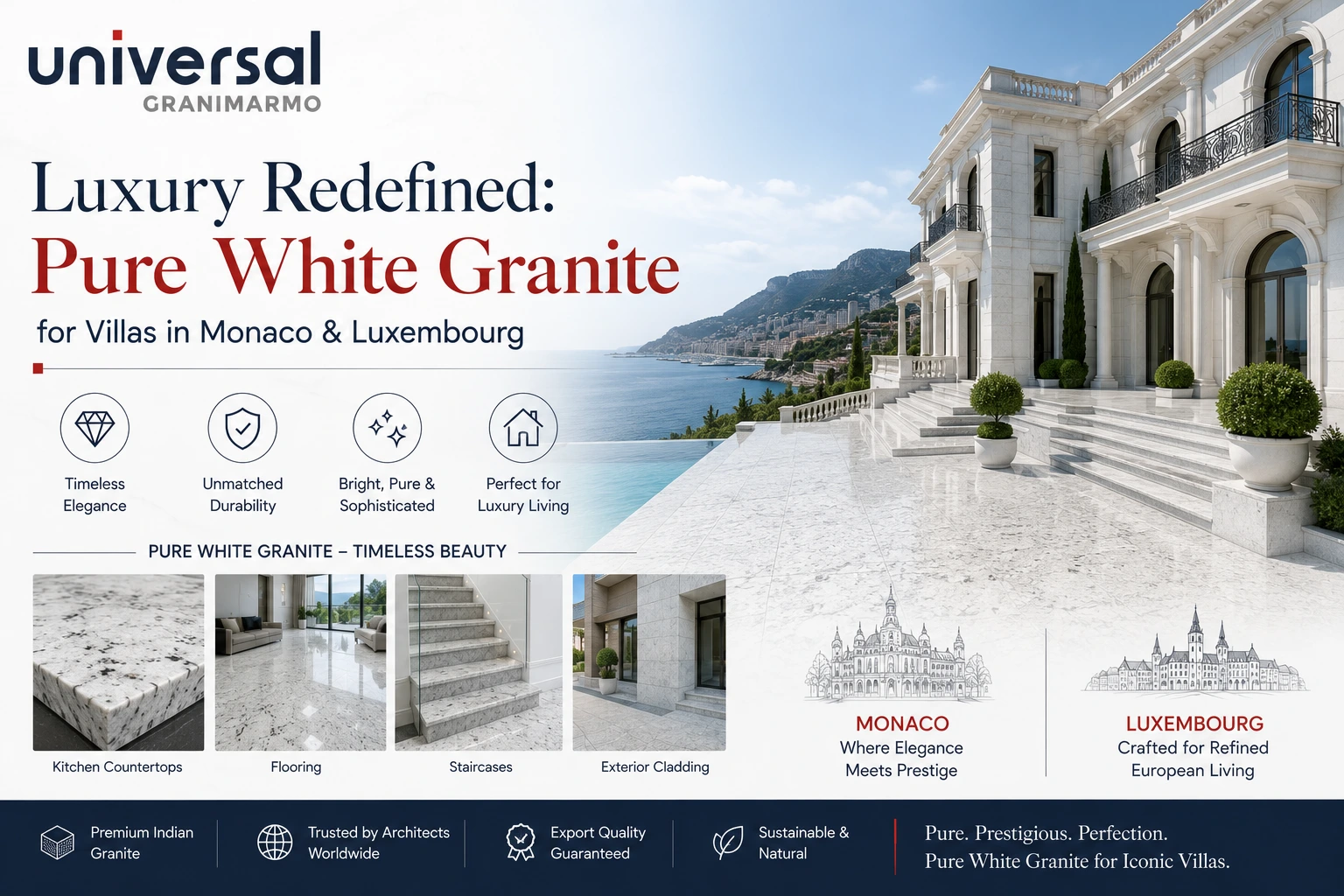
There is a particular kind of restraint that defines true luxury architecture in Monaco and Luxembourg. It isn’t about ornamentation or excess — it’s about material honesty. A villa overlooking the Mediterranean in Monte Carlo, or a discreet estate tucked into the hills above Luxembourg City, doesn’t need to shout. It needs a material that speaks quietly and permanently of quality. For architects, interior designers, and private buyers working at this level, pure white granite has become that material.
This is a long read, deliberately so. Specifying stone for a villa in Monaco or a private estate in Luxembourg is not a decision made quickly, and the questions that matter — origin, veining consistency, slab matching, finish, installation, and long-term performance — deserve a proper answer rather than a surface-level overview. What follows is a detailed guide to why pure white granite has become the material of choice at the very top of the European residential market, and what buyers and specifiers should know before committing to it.
Why Monaco and Luxembourg Set the Tone for European Luxury Design
Monaco and Luxembourg occupy a unique position in European real estate. Monaco’s built environment is famously constrained — a tiny principality where land is scarcer, and therefore more valuable, than almost anywhere else on earth. Every square metre of a Monégasque villa is considered, and the materials used inside it are expected to justify that value for decades, not years. Luxembourg, meanwhile, has quietly become home to one of Europe’s highest concentrations of private wealth, with a discreet, understated aesthetic sensibility that favours quality over visible extravagance.
In both markets, the brief from clients to architects is remarkably consistent: material choices must be timeless, low-maintenance, and unmistakably premium — without looking like they are trying to be. Pure white granite meets that brief in a way that few other materials can.
What “Pure White Granite” Actually Means
The term is used loosely in the market, so it’s worth being precise. Pure white granite refers to granite varieties with a near-solid white or off-white base, minimal dark mineral flecking, and — in the finest grades — very subtle, almost translucent veining rather than heavy grain patterning. This distinguishes it from more common “white granite” varieties, which often carry visible black, grey, or gold speckling from mica and feldspar content.
True pure white granite is rarer at quarry level because it requires an unusually consistent mineral composition across the block — high quartz and feldspar content with minimal biotite or hornblende. That rarity is part of what makes it a genuine luxury material rather than a marketing label. It is also why sourcing matters enormously: not every supplier claiming “pure white granite” is actually offering the same grade of stone.
Why Pure White Granite Outperforms Marble for Luxury Villas
Marble has traditionally been the default material associated with luxury interiors, and Carrara marble in particular remains a design touchstone. But marble carries real practical drawbacks that become more pronounced the longer a property is lived in:
- Porosity — marble absorbs oils, wine, and acidic liquids far more readily than granite, leading to staining over time even with careful maintenance
- Softness — marble scratches and etches more easily, which matters enormously in high-use areas like kitchen islands, bathroom vanities, and staircases
- Etching from acids — even diluted lemon juice or vinegar can dull marble’s polished surface permanently
- Higher long-term maintenance costs — marble typically needs more frequent professional resealing and polishing to maintain its appearance
Pure white granite delivers a comparably luxurious, bright aesthetic while being significantly harder, denser, and less porous. For villa owners who want the material to still look flawless in twenty years — not just at handover — this durability difference is often the deciding factor.
Applications: Where Pure White Granite Is Used in Luxury Villas
Pure white granite’s versatility is part of its appeal. In high-end residential projects across Monaco and Luxembourg, it typically appears in:
Kitchen Countertops and Islands
The kitchen is often the single largest visible stone application in a luxury villa, and pure white granite countertops provide a bright, clean backdrop that works equally well with matte black fittings, brushed brass, or natural oak cabinetry. See the full white granite countertops range for finish options.
Bathroom Vanities and Wet Rooms
Because pure white granite resists moisture and staining far better than marble, it has become the preferred choice for master ensuite vanities, walk-in showers, and spa-style wet rooms — spaces where a villa’s luxury credentials are often most closely scrutinised by guests and buyers alike.
Grand Staircases and Entryways
A staircase is frequently the first material statement a visitor encounters. Pure white granite, cut and finished for staircase applications, delivers a bright, monumental first impression while offering far better slip resistance and durability than polished marble treads. See granite stairs design ideas for high-end residences.
Facades and Exterior Cladding
Monaco’s Mediterranean climate and Luxembourg’s more temperate, wetter conditions both demand exterior stone that resists weathering without discolouring. Pure white granite’s low porosity makes it a durable choice for facade cladding, poolside terraces, and garden features that need to withstand years of sun, rain, or frost without fading.
Feature Walls and Interior Cladding
Beyond functional surfaces, large-format pure white granite panels are increasingly used as feature wall cladding in living areas, wine cellars, and home cinemas — spaces where the stone’s visual purity becomes the design statement itself.
The Specification Challenge: Consistency at Scale
The single biggest challenge in sourcing pure white granite for a villa project is consistency. A property might require dozens of slabs across kitchen counters, bathroom vanities, flooring, and staircases — and any visible variation between slabs undermines the seamless, monumental look that defines luxury stonework.
This is where sourcing decisions matter more than most buyers initially realise. Achieving true consistency requires:
- Single-quarry, single-batch sourcing — slabs cut from the same block, or immediately adjacent blocks, to minimise tonal variation
- Book-matching capability — the ability to cut and arrange slabs so veining patterns mirror each other across a surface, a technique often used for statement walls and large kitchen islands
- Sufficient quarry reserves — a supplier needs enough raw material available to fulfil an entire project’s requirement without switching to a different block partway through
- Rigorous quality control at the processing stage — inconsistent polishing or edge-finishing between slabs is a common, avoidable failure point in luxury projects
Buyers and architects should always request to see slabs in person, or via detailed slab photography, before finalising an order — and should insist on batch traceability so that reorders (for future repairs or extensions) can be matched as closely as possible.
Sourcing Pure White Granite from India
India’s granite belt, particularly across Rajasthan and parts of southern India, produces some of the world’s most sought-after pure white granite varieties, prized for their mineral purity and large, consistent quarry reserves. This scale is precisely what allows a single supplier to fulfil the demands of a full villa project — kitchen, bathrooms, staircases, flooring, and facade — from matched material.
Universal Granimarmo has exported granite, marble, sandstone, and slate since 2013, with production spanning multiple units across Rajasthan and southern India. For architects and private clients working on Monaco or Luxembourg villa projects, this means access to substantial pure white granite reserves, book-matching capability for feature applications, and the batch consistency that large-scale luxury projects demand. Read more about the company and its export journey, or browse the broader granite stone catalogue for complementary colours used in mixed-material villa designs.
A Practical Checklist for Villa Projects
For architects and private buyers evaluating pure white granite for a Monaco or Luxembourg project, a few questions are worth resolving early:
- Is the quarry reserve large enough to supply the full project from one consistent source, including a margin for future repairs?
- Can the supplier provide book-matched slabs for feature walls, islands, or staircases where pattern continuity matters most?
- What finish options are available — polished for interior brightness, honed for a softer contemporary look, or leathered for a textured, fingerprint-resistant surface?
- What is the realistic lead time, factoring in quarrying, processing, quality control, and shipping to Monaco or Luxembourg specifically?
- Is technical documentation available — density, water absorption, and compressive strength data — for any application requiring building compliance sign-off?
- What installation partners or guidance does the supplier offer to ensure the stone is fitted by installers experienced with large-format luxury applications?
Answering these before committing to a supplier avoids the most common and costly mistake in luxury stone projects: discovering partway through installation that remaining material doesn’t match what’s already been fitted.
Frequently Asked Questions
What makes granite “pure white” rather than just “white”?
Pure white granite has a near-solid white or off-white base with minimal visible dark mineral flecking and only subtle veining, resulting from an unusually consistent quartz- and feldspar-rich mineral composition at the quarry. Standard “white granite” varieties often show more visible speckling from mica or other minerals.
Is pure white granite more expensive than standard white granite?
Generally, yes. Its rarity at quarry level, combined with the higher wastage involved in selecting only the most consistent blocks, typically places pure white granite at a premium price point compared to more common white granite varieties with visible speckling.
How does pure white granite compare to Carrara marble for a villa?
Pure white granite offers a comparably bright, luxurious appearance to Carrara marble but with significantly better resistance to staining, etching, and scratching. Marble remains softer and more porous, requiring more frequent resealing and careful maintenance to avoid permanent marks — a maintenance burden many villa owners prefer to avoid.
Can pure white granite be used both indoors and outdoors on the same property?
Yes. Pure white granite’s low porosity and weather resistance make it suitable for both interior applications (countertops, flooring, staircases) and exterior use (facades, terraces, poolside paving), which allows a consistent material palette across an entire villa, indoors and out.
How is book-matching done with granite, and is it possible with white granite?
Book-matching involves cutting a block into consecutive slabs and arranging them so the veining mirrors like an open book. It is achievable with pure white granite provided the quarry block has enough consistent veining to make the mirrored effect visually striking — this should be discussed and confirmed with the supplier before ordering.
What finish is best for a Monaco villa’s poolside terrace?
A flamed or leathered finish is generally recommended for poolside and exterior terrace applications, since these finishes provide better slip resistance underfoot when wet compared to a high-gloss polished finish, without compromising the stone’s bright appearance.
How long does it take to source and install pure white granite for a full villa project?
Timelines vary significantly by project scope, but buyers should generally allow for several months from initial quarry selection and slab approval through processing, shipping to Monaco or Luxembourg, and professional installation — longer than a standard single-room renovation given the volume and matching requirements involved.
Does pure white granite require different sealing or maintenance than other granite colours?
Not fundamentally, though lighter stones can show dirt or residue more visibly than darker granites, so a slightly more frequent cleaning routine is sometimes recommended for high-use surfaces like kitchen islands, even though the sealing schedule itself remains similar to other granite types — typically resealed every one to two years depending on use.
Can Universal Granimarmo supply enough matched slabs for a full villa project?
Yes. With production spanning multiple quarry units across Rajasthan and southern India, Universal Granimarmo can typically source sufficient consistent material for large-scale residential projects, including book-matched slabs where required — though early engagement is recommended so slab selection and quarry allocation can be planned ahead of the project’s installation schedule.