
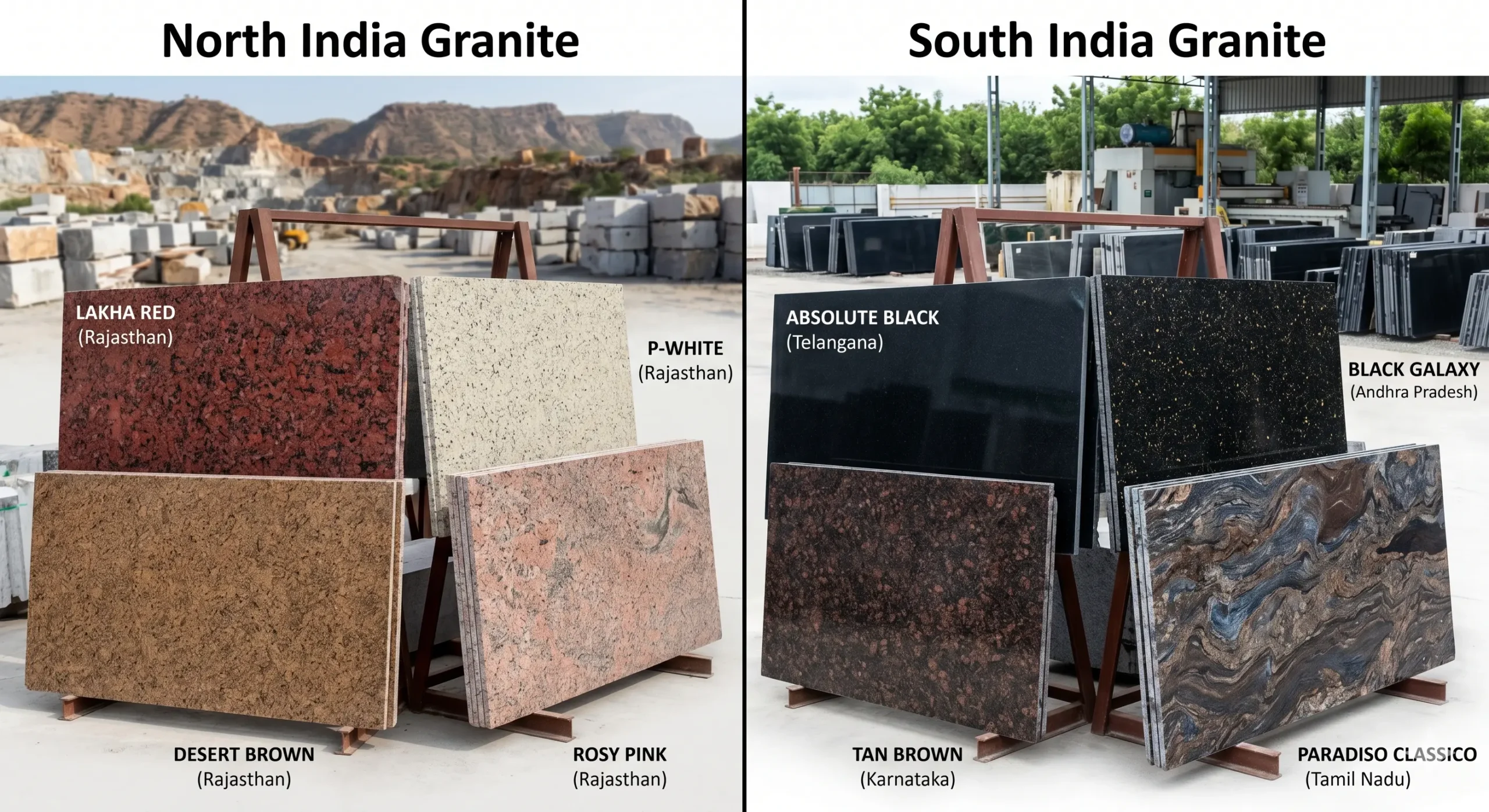
India is one of the most geographically diverse granite-producing nations in the world — but not all Indian granite is the same. The stone quarried in the sun-baked hills of Rajasthan behaves, looks, and performs differently from the dense, crystalline granite pulled out of the ancient rock formations of Andhra Pradesh or Karnataka.
At Universal Granimarmo, we operate manufacturing facilities in both regions — in Jalore and Ajitgarh in the North, and in Ongole and Karimnagar in the South. That gives us a perspective that most suppliers simply don’t have: daily, hands-on experience with both granite families, from the moment the block leaves the quarry to the moment the slab reaches a project site.
This guide is our honest, first-hand account of the key differences between North Indian and South Indian granite — so you can choose the right stone for the right application, every time.
The Geography Behind the Stone
Understanding the differences starts underground.
North India
primarily Rajasthan, along with parts of Punjab and Madhya Pradesh — sits on granite formations that are geologically younger and were formed under different pressure and temperature conditions. Rajasthan’s granite deposits span 23 districts, with the most active quarrying zones in Jalore, Pali, Rajsamand, and Jhansi (Madhya Pradesh border).
South India
Spanning Andhra Pradesh, Telangana, Karnataka, and Tamil Nadu — sits on some of the oldest Precambrian rock formations on earth. The Deccan Plateau geology produces stone with exceptional mineral density, deep colour consistency, and extremely low porosity. The most celebrated quarry zones include Chimakurthy (Ongole) for Black Galaxy, Karimnagar for black granite, Chamarajanagar (Karnataka) for Absolute Black, and the Vizag belt for blue-grey varieties. The age and geological conditions of the host rock directly determine the visual character, technical performance, and quarry yield of the granite.
At a Glance: North vs South Indian Granite
| Feature | North Indian Granite | South Indian Granite |
| Primary states | Rajasthan, Punjab, MP | Andhra Pradesh, Telangana, Karnataka, Tamil Nadu |
| Colour palette | Bold, warm, multi-tonal | Deep, consistent, often dark |
| Grain structure | Medium to coarse | Fine to medium, dense |
| Popular colours | Strong in the USA, Europe, the Far East, Gulf | Black, grey, white, blue, tan |
| Global popularity | Strong in the USA, Europe, Far East, Gulf | Strong in the Middle East, Turkey, and domestic India |
| Price point | Generally more affordable | Moderate to premium |
| Best applications | Flooring, landscaping, heritage, facades | Countertops, cladding, high-traffic floors |
| Nearest major port | Mundra, Kandla (Gujarat) | Chennai, Krishnapatnam |
Colour Palette: Warm, Bold North vs Deep, Consistent South
This is the most visible difference between the two regions — and it matters enormously for design.
North Indian Granite Colours
North Indian granites — especially those from Rajasthan — are characterised by warm, earthy, often multi-tonal colour profiles. The natural mineral composition (higher feldspar, mica, and quartz ratios) produces stones that look rich and textural rather than uniform.
Popular North Indian varieties and their tones:
- Crystal Yellow — Golden yellow with black flecks; quarried in Jalore and the Gujarat border
- Rosy Pink / Bala Flower — Pink-peach tones with grey and black veining; Jalore region; extremely popular in Turkey and Gulf
- Lakha Red / Jhansi Red — Deep red with black and white mineral inclusions; Jhansi district, MP
- Alaska White — Off-white/grey with subtle speckle; versatile and popular in interiors
- Desert Brown / Tan Brown (North) — Warm brown with multi-mineral patterning
- Rajasthan Black / R Black — Black base with brown or red mineral spots; Rajsamand
- Fantasy Brown — White-grey-brown swirling patterns; Rajasthan; loved by interior designers
- Blue Dunes / Colonial Blue — Blue-grey tones unique to Rajasthan; increasingly popular in Europe
The defining characteristic: no two slabs are identical. North Indian granite is for buyers who want personality and warmth in their stone.
South Indian Granite Colours
South Indian granites are celebrated worldwide for exactly the opposite quality: deep, consistent colour with a crystalline density that polishes to a near-mirror finish.
Popular South Indian varieties and their tones:
- Black Galaxy (Star Galaxy) — Jet black with gold/silver metallic flecks; quarried exclusively in Chimakurthy, Ongole, Andhra Pradesh. UGM’s Ongole factory is in the heart of Black Galaxy country.
- Absolute Black (Nero Absolute) — Pure, uniform deep black; Karnataka and Andhra Pradesh; globally the most exported black stone
- Steel Grey — Consistent mid-grey with fine mineral grain; Andhra Pradesh; widely used in airports, malls, government buildings
- Tan Brown — Rich chocolate-brown with black and red inclusions; quarried in the Chimakurthy area
- Kashmir White — White/grey background with dark grey and burgundy mineral clusters; a premium global export
- Vizag Blue — Rare blue-grey stone; quarried near Visakhapatnam; used in luxury projects
- Hassan Green — Deep forest green with black mineral patterning; Karnataka
The defining characteristic: colour consistency across thousands of square metres. South Indian granite is for projects that demand uniformity at scale.
Technical Properties: How They Compare
Hardness and Density
South Indian granites, formed in ancient Precambrian rock under immense geological pressure, are among the densest natural stones available commercially. Black Galaxy granite, for example, has a bulk density of 2,930 kg/m³ and a compressive strength of approximately 2,370 kg/cm² — among the highest recorded for commercially quarried granite globally.
North Indian granites are also genuinely hard and durable — well within international standards for construction use — but typically register slightly lower density values due to their coarser grain structure and higher feldspar content. This makes them slightly easier to cut and process, which contributes to their competitive pricing.
Porosity and Water Absorption
South Indian granites, particularly Absolute Black and Black Galaxy, have some of the lowest water absorption rates in the natural stone world — as low as 0.02% for Black Galaxy. This makes them ideal for kitchen countertops, wet areas, and exterior applications in humid or coastal climates.
North Indian granites have somewhat higher water absorption rates (typically 0.1–0.4%), which means sealing is more important, especially for countertop and bathroom applications. For flooring and landscaping use, this difference is negligible.
Thermal Properties
Both regions produce granite with strong thermal resistance, making either suitable for kitchen countertops. South Indian black granites dissipate heat slightly more efficiently due to their mineral density — a practical advantage in hot-climate countries like the UAE, Oman, and Qatar.
North Indian granites — particularly the lighter-coloured varieties — reflect more heat when used outdoors, making them a preferred choice for sun-facing exteriors, terraces, and courtyard paving in hot climates.
Applications: Where Each Region’s Stone Shines
North Indian Granite — Best Applications
Landscaping and outdoor paving Rajasthan’s pink, yellow, and red granites are widely used in garden paving, driveway kerbstones, pathway tiles, and pool surrounds. Their warm tones complement outdoor greenery, and they’re excellent at masking surface dust and footwear marks.
Heritage restoration and civic projects. Many Indian government buildings, railway stations, and civic infrastructure projects specify Rajasthan granite. Its warm colour palette blends with India’s architectural heritage, and it has been used in major projects including airport terminals, university campuses, and state government complexes.
Facades and wall cladding, Fantasy Brown, Alaska White, and Rajasthan Black, create striking wall cladding panels. The variation in patterning ensures no two panels look identical, valued in high-design architectural projects.
Flooring in warm-toned interiors, Crystal Yellow and Rosy Pink granite bring warmth to residential and hospitality interiors. They work particularly well in traditional, heritage, and transitional design styles.
South Indian Granite — Best Applications
Kitchen and bathroom countertops, South Indian granites — especially Absolute Black, Black Galaxy, Tan Brown, and Steel Grey — dominate the global countertop market. Their low porosity, mirror polish quality, and scratch resistance make them the professional’s top choice for kitchen work surfaces.
High-traffic commercial flooring: Airports, malls, hospitals, and hotel lobbies worldwide specify South Indian granites for large-format floor tiles. Steel Grey and Absolute Black maintain their appearance under intense foot traffic for decades.
Exterior facades on landmark projects, UGM has supplied South Indian granite for major projects, including a presidential palace in Abu Dhabi and a university campus in Oman, both requiring uniform stone that would match consistently across thousands of square metres of facade cladding. Only South Indian granite delivers that reliability at scale.
Monumental and memorial installations. The high density, deep colour, and superb polish of South Indian granites make them the global standard for memorial stones, grave markers, and monument installations — a significant export category to the USA, Japan, and Europe.
Availability and Lead Times
North Indian granite from Rajasthan benefits from Mundra and Kandla ports (Gujarat), which offer competitive freight rates and fast loading turnarounds. Production lead times for standard varieties are typically 2–3 weeks from the factory.
South Indian granite is typically shipped from Chennai, Krishnapatnam, or Nhava Sheva. The quarrying and processing ecosystem in Andhra Pradesh and Karnataka is deeply mature — large volumes of standard varieties like Absolute Black and Steel Grey are often available from finished stock, reducing lead time to 1–2 weeks.
For UGM buyers: because we operate factories in both regions, we can fulfil mixed-origin orders — North and South Indian stone on the same shipment — from a single invoice and documentation set.
Pricing: What to Expect
Both regions offer competitive pricing by global standards, but there are meaningful differences:
North Indian granite is generally priced 10–30% lower than equivalent South Indian stone, driven by:
- Lower freight costs to major North Indian ports
- Higher quarry availability and competition in Rajasthan
- Generally, lower processing costs
South Indian granite commands a premium for:
- Higher mineral density and polish quality
- Global brand recognition (Black Galaxy, Absolute Black)
- Lower porosity = higher performance = premium applications
As a general indicator, FOB prices from India for polished slabs range:
- Standard North Indian varieties: USD 12–25 per sqm (FOB)
- Premium North Indian varieties: USD 25–50 per sqm (FOB)
- Standard South Indian varieties: USD 18–35 per sqm (FOB)
- Premium South Indian varieties (Black Galaxy, Kashmir White): USD 40–80+ per sqm (FOB)
Prices vary based on thickness, finish, slab size, and market conditions. Contact UGM for a current quotation.
Which Should You Choose?
The answer depends entirely on your project’s priorities:
Choose North Indian granite if:
- You want warm, characterful tones (yellows, pinks, reds, browns)
- Budget is a key consideration
- The application is landscaping, outdoor paving, or decorative flooring
- You value natural variation and individuality in each slab
- The project has a heritage, traditional, or warm-contemporary aesthetic
Choose South Indian granite if:
- You need absolute colour consistency across large areas
- The application is for kitchen countertops, wet areas, or high-traffic floors
- The project is a landmark, institutional, or luxury development
- You need certified technical performance (low water absorption, high compressive strength)
- The design is contemporary, minimalist, or monochromatic
The UGM advantage: As a manufacturer with factories in both regions, we don’t have a commercial incentive to recommend one over the other. We recommend the right stone for your project — even if that means combining both in the same order.
Frequently Asked Questions
Q: Is South Indian granite always better than North Indian granite?
No. They serve different purposes. South Indian granite excels in performance-critical applications. North Indian granite excels in warmth, texture, and decorative appeal. Neither is universally “better.”
Q: Can I use North Indian granite for kitchen countertops?
Yes, with proper sealing. Fantasy Brown and Alaska White, for example, are used for kitchen countertops in India and globally. However, for commercial kitchens or high-use countertops, South Indian granite’s lower porosity is a practical advantage.
Q: Does granite from different regions of India look different in natural light vs artificial light?
Yes, significantly. Black Galaxy granite’s golden flecks become dramatically more visible under spotlights. North Indian yellows and reds appear richer under warm artificial light but may wash out slightly in cool daylight. Always view samples under the lighting conditions of the intended space.
Q: Which Indian granite is most popular in the UAE?
Both regions are well represented. Black Galaxy, Absolute Black, and Steel Grey (South) are popular for interior flooring and commercial projects. Rosy Pink, Crystal Yellow, and sandstone from Rajasthan (North) are popular for landscaping, outdoor paving, and residential villa projects.
Q: Can UGM supply both North and South Indian granite on a single order?
Yes. With manufacturing units in Jalore (Rajasthan) and Ongole/Karimnagar (Andhra Pradesh), UGM can consolidate mixed-region orders into a single shipment with unified documentation.
Conclusion
India’s granite story is really two stories — one from the warm, ancient deserts of the North and one from the dense, dark rock formations of the South. Both produce world-class stone. Both have a place in great architecture.
At Universal Granimarmo, we’ve spent over a decade working with both granite families — quarrying, processing, and exporting to buyers across the UAE, USA, Oman, Qatar, Turkey, and Europe. Our multi-factory model means you’re not limited to what one region produces. You get honest advice, consistent quality, and access to the full spectrum of Indian granite from a single, verified manufacturer.