
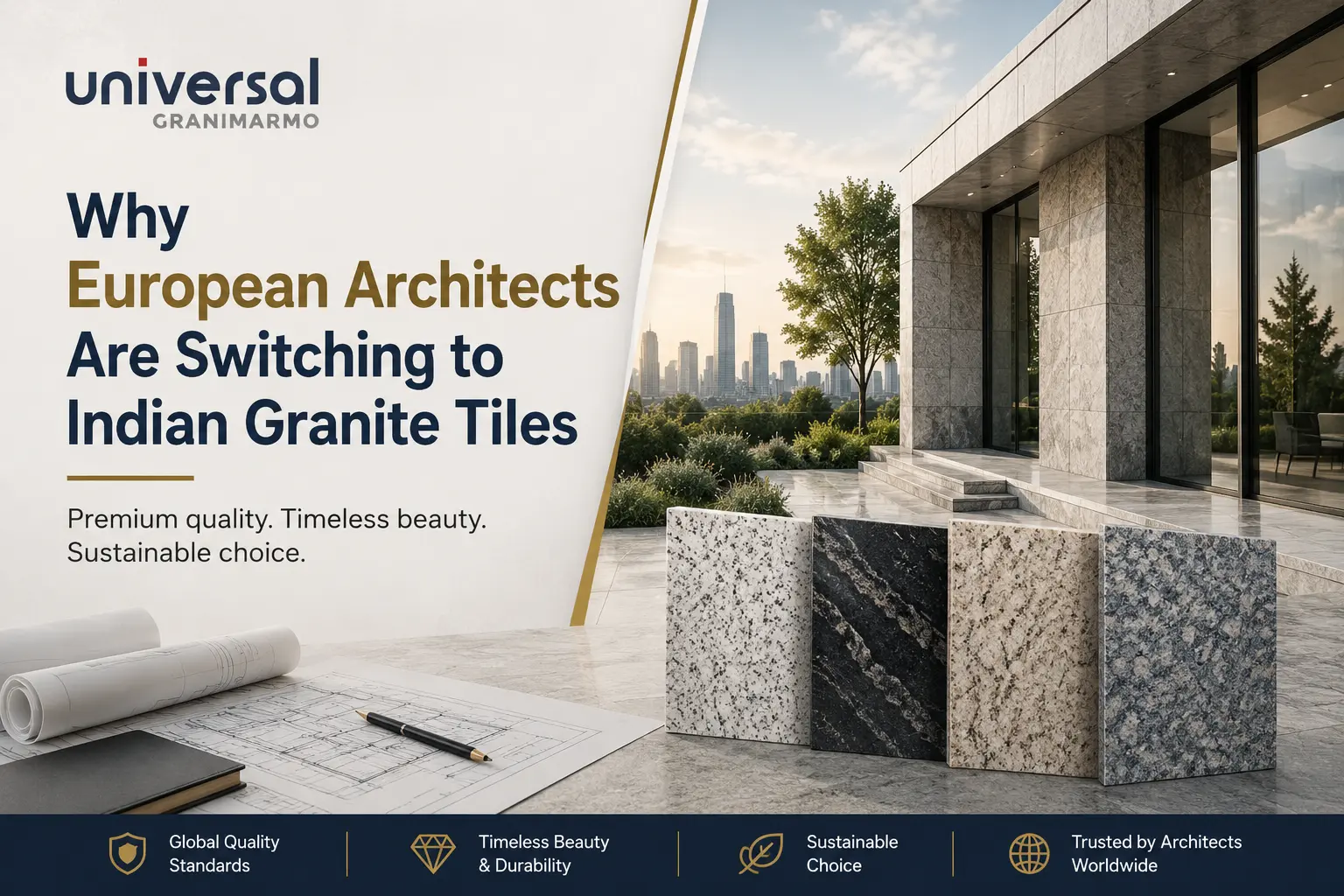
Something significant is happening in European architecture studios right now. Across London’s adaptive reuse projects, Barcelona’s waterfront developments, Copenhagen’s sustainable housing initiatives, and Brussels’ commercial renovations, natural stone is enjoying a powerful resurgence — and increasingly, that stone is coming from India.
This is not a passing trend driven by price alone. European architects are sophisticated, specification-driven professionals who choose materials based on performance data, sustainability credentials, aesthetic range, and long-term project accountability. When they switch, they switch for good reasons.
At Universal Granimarmo, we export Indian granite to buyers across Europe — from interior fit-outs in Germany to facade cladding projects in the UK, from landscape architecture in Belgium to hospitality projects in the Netherlands. We see the shift happening firsthand, order by order, project by project.
This article breaks down exactly why it’s happening — and what it means for architects, developers, and stone buyers working on European projects in 2026.
The Scale of the Shift: What the Numbers Say
India’s position in global granite exports is not marginal — it is dominant. During financial year 2023–24, India retained its number-one position worldwide in granite exports, with shipments to major European markets including France, Germany, Belgium, Italy, and the UK consistently growing year on year.
The global natural stone market was valued at USD 37.89 billion in 2025 and is forecast to reach USD 49.66 billion by 2031 — a 4.62% compound annual growth rate. Granite accounts for 31% of that market by value, driven precisely by the applications European architects most commonly specify: high-traffic commercial flooring, facade cladding, civic paving, and hospitality interiors.
Within that growth story, Indian granite is taking an increasing share of European specification — and the reasons are structural, not accidental.
The Authenticity Shift in European Design
The single most important driver of Indian granite’s rise in European architecture is a fundamental shift in design values.
For roughly two decades, the European commercial and residential design market was dominated by engineered surfaces — porcelain, composite stone, large-format ceramic tiles — valued for their uniformity, predictability, and ease of supply. These materials still hold significant market share. But the design conversation in 2026 has moved decisively in a different direction.
European architects are now deliberately embracing natural stone in its most authentic, characterful state. Stones with natural variation, visible mineral movement, raw split-face finishes, and the kind of organic imperfection that declares a material’s geological origin are being specified on prestige projects across the continent. This represents a direct reaction against the visual homogeneity of engineered surfaces and connects to broader cultural movements toward authenticity, materiality, and transparency in design.
Indian granite sits perfectly in this shift. With over 200 commercially available varieties spanning black, grey, white, gold, red, green, pink, and blue — each with distinct mineral character — Indian granite offers European architects the authentic natural stone they want, in a range that domestic European quarries simply cannot match.
India Offers Colours Europe Cannot Quarry
This is a purely practical point that is reshaping specification decisions across the continent.
Europe’s domestic granite production — primarily from Scandinavia, Portugal, Spain, and Germany — covers a relatively limited colour range. Nordic granites tend toward grey and blue-grey. Iberian granites lean pink, grey, and black. The palette is solid but constrained.
India produces granite varieties that exist nowhere else in the world:
Black Galaxy — jet black with gold and silver metallic mineral flecks, quarried exclusively in Chimakurthy, Ongole, Andhra Pradesh. UGM operates a production facility in the Chimakurthy belt. No European quarry produces anything remotely like it.
Fantasy Brown — a marble-look granite with flowing grey, brown, and green veining on a warm cream base; quarried in Rajasthan. Architects specifying the warmth of Italian marble but needing granite’s performance durability increasingly turn to Fantasy Brown as the intelligent solution.
Crystal Yellow — a warm golden tone from Jalore, Rajasthan, with no close equivalent in European quarry production. Increasingly specified in Mediterranean and hospitality projects across Spain, Italy, and the South of France.
Vizag Blue — a rare blue-grey granite from Visakhapatnam; specified for luxury and landmark projects where a unique, distinctive material is required.
Hassan Green — a deep forest green from Karnataka, enjoying a surge in popularity among European architects, attracted to grounded, nature-connected colour palettes in 2026. For European architects designing with colour ambition, Indian granite is not a compromise choice — it is often the only choice.
Sustainability Credentials That Now Pass European Scrutiny
Sustainability is no longer a marketing consideration for European architects — it is a procurement requirement. EU building regulations, BREEAM and LEED certification requirements, and increasingly stringent corporate ESG standards have made life-cycle assessment (LCA) and environmental product declarations (EPDs) a standard part of material specification in Europe.
Natural granite from responsibly managed Indian quarries performs strongly against these criteria:
Longevity: Granite installed on a European building facade or public plaza has a functional lifespan measured in centuries, not decades. European municipalities now require life-cycle assessments for plaza refurbishments, and granite’s multi-generational durability makes its embodied carbon case compelling — the carbon cost of production is amortised over an exceptionally long service life.
No synthetic content: Unlike engineered surfaces that contain polymer resins and chemical binders, natural granite is 100% mineral. It does not off-gas, does not degrade into microplastics, and can be fully recycled or reused at the end of building life.
Thermal mass: European architects increasingly specify natural stone facades for thermal mass benefits — the ability of dense stone to absorb heat during the day and release it slowly at night, reducing HVAC demand. Indian granite’s high mineral density makes it an excellent thermal mass material for European climate conditions.
Replacing aluminium panels: A growing trend in European building renovation involves replacing aging aluminium facade panels with ventilated natural-stone rain-screen cladding systems. This improves thermal mass, extends building life, and enhances the building’s aesthetic character. Indian granite’s availability in large-format panels at competitive pricing makes it a compelling specification for this application. Sustainable Indian granite exporters who can provide transparent information about sourcing, processing, and logistics are finding themselves preferred partners for sustainability-focused European firms — and that is exactly the direction the European specification market is moving.
Performance That Exceeds European Standards
Indian granite — particularly the South Indian varieties quarried from ancient Precambrian rock formations — meets and frequently exceeds the technical performance standards required by European specifications.
The key European standards governing natural stone in construction are:
- EN 1469 — Natural stone products; slabs for cladding
- EN 12057 — Natural stone products; modular tiles
- EN 12058 — Natural stone products; slabs for floors and stairs
- EN 1341 / EN 1342 / EN 1343 — Slabs, sets, and kerbs of natural stone for external paving
Indian granite typically performs strongly across the technical parameters these standards measure:
| Technical Parameter | South Indian Granite (typical) | EN Standard Requirement |
| Compressive strength | 2,000–2,500 kg/cm² | Min. 500 kg/cm² |
| Water absorption | 0.02–0.15% | Max. 0.40% |
| Modulus of rupture | 150–220 kg/cm² | Min. 60 kg/cm² |
| Abrasion resistance | Class 1 (high resistance) | Class 1 required for heavy traffic |
| Frost resistance | Passes EN 12371 | Required for exterior EU applications |
For European architects specifying stone on public infrastructure, civic plazas, transport hubs, or exterior facades, this performance profile eliminates the technical objection to Indian granite entirely.
India’s Processing Technology Has Closed the Quality Gap
Ten years ago, a legitimate concern among European architects was the consistency of Indian granite processing — finish uniformity, dimensional accuracy, and edge quality. That concern is now largely historical.
India’s leading granite manufacturers have invested heavily in modern CNC cutting, automated polishing lines, laser calibration, and computer-controlled quality inspection systems. The result is dimensional tolerances that match European production benchmarks: thickness tolerance within ±1mm, squareness within ±1.5mm on standard tile formats, and surface flatness controlled to ±0.3mm per metre.
At UGM, our five production facilities operate modern processing equipment across all our granite lines — from 10mm wall cladding panels to 30mm countertop slabs and large-format paving tiles. Our export quality is verified against international standards before shipment, and we provide full documentation packages for European import requirements. Large-format slabs — 120×60 cm, 240×120 cm, 260×160 cm — are now routinely produced by Indian granite manufacturers at consistent quality, opening up the large-format specification possibilities that European commercial architecture increasingly demands.
Indian Granite Harmonises with Historic European Stone
One of the most architecturally interesting dimensions of the European shift to Indian granite is the heritage restoration market.
Rajasthan granite exporters are finding strong demand from Belgium and the Netherlands because certain Indian granites closely resemble historic Belgian bluestone in colour and texture, while offering superior durability and more reliable availability. Similarly, specific Indian granites are being specified for projects in the UK because they harmonise with local historic stone while meeting contemporary performance requirements.
This is not about creating deceptive replicas — it is about acknowledging that geological processes create similar materials in different locations worldwide. Architects appreciate that they can achieve aesthetic continuity with historic contexts while accessing materials from more sustainable and economically viable sources. This has created fascinating collaborations between European heritage architects and Indian quarry operators, with Indian manufacturers producing matched stone to within tight colour and texture tolerances specified by the project architect.
For European conservation-area projects — a significant specification category in the UK, Belgium, and Germany — Indian granite opens up material possibilities that neither domestic quarries nor synthetic surfaces can provide.
Competitive Pricing That Reaches Where European Stone Cannot
The economic argument for Indian granite is straightforward but worth stating clearly.
Sourcing granite direct from an Indian manufacturer like UGM, rather than through a European stone merchant or intermediary, typically delivers savings of 30–50% on the material cost for equivalent quality stone. On a large facade cladding project or civic paving contract, that saving is transformative for project economics.
The cost advantage is not a quality compromise — it reflects the genuine cost structure of Indian production: lower energy costs, lower labour costs, proximity to quarry sources, and a mature, competitive processing industry. European architects who have visited Indian granite facilities report being surprised by the sophistication of the equipment and the quality of the output. For developers and public sector clients working within defined budgets, the ability to specify a premium-performing, authentically natural material at a competitive price point — often while upgrading from an engineered surface in the original specification — makes Indian granite an increasingly compelling choice.
What European Architects Are Specifying from India in 2026
Based on UGM’s current export patterns and the broader trends visible in European stone trade, these are the Indian granite varieties most actively specified by European architects in 2026:
Steel Grey — the most consistently specified Indian granite across European commercial projects. Its neutral grey tone pairs effortlessly with glass, steel, and timber — the material palette of contemporary European commercial architecture. Widely used for flooring, facade panels, and public paving.
Absolute Black — dominates the minimalist and monochrome design sector across Northern Europe. Uniform, deeply black, and polishes to exceptional quality. Specified for retail interiors, corporate headquarters, and contemporary residential projects.
Black Galaxy — the prestige specification choice for luxury hospitality, high-end residential, and statement commercial projects. Unique in the global market and consistently associated with premium design.
Kashmir White — a strong performer in Scandinavian and Northern European markets, where bright, light-reflective interiors are valued. The white-and-grey palette with burgundy mineral accents brings genuine natural character to interiors that lighter, blander stones cannot match.
Fantasy Brown — growing rapidly among European architects who want the warm, veined character of Italian marble with granite’s practical performance. Particularly strong in the UK, Germany, and the Netherlands.
Hassan Green — emerging strongly in 2026, driven by European architects’ interest in grounded, nature-connected colour palettes and biophilic design principles.
How to Specify Indian Granite for a European Project
For European architects and developers new to sourcing Indian granite, the specification process has become considerably more streamlined in recent years.
CE Marking and EN Standards: Reputable Indian granite exporters can supply CE-marked stone with full EN standard test certificates, enabling straightforward compliance with European Construction Products Regulation requirements. Always request EN-compliant test reports as part of your material specification package.
EPDs and Sustainability Documentation: Leading Indian manufacturers can provide Environmental Product Declarations and carbon footprint data for specification on BREEAM or LEED-rated projects. Request this documentation explicitly in your RFQ.
Sample and Lot Approval: Always request physical samples and approve them against your specification before confirming the order. For large projects requiring consistent colour matching, request photographs of the allocated quarry batch slabs before production begins.
Logistics: Standard transit from Indian ports (Mundra, Chennai, Krishnapatnam) to European ports (Rotterdam, Antwerp, Felixstowe, Hamburg) runs approximately 20–28 days. Plan your specification timeline accordingly, particularly for projects with phased construction programmes.
Single-Source Advantage: Working with a multi-facility Indian manufacturer like UGM — with quarrying and processing across both Rajasthan and South India — allows a single supplier relationship for the full range of Indian granite colours and formats needed across a complex project.
Frequently Asked Questions
Q: Do Indian granite tiles meet European EN standards for external facades?
Yes. Leading Indian granite manufacturers supply stone tested and certified against EN 1469 (slabs for cladding), EN 12058 (flooring), and EN 12371 (frost resistance) — the key standards for European facade and exterior specification. Always request EN test certificates from your supplier.
Q: Is Indian granite eligible for BREEAM credits under the materials category?
Yes, subject to the availability of Environmental Product Declarations and responsible sourcing documentation. UGM can provide sustainability documentation for European BREEAM and LEED projects on request.
Q: Can Indian granite be specified for frost-exposed exterior applications in Northern Europe?
Yes. South Indian granites with very low water absorption rates (0.02–0.15%) pass EN 12371 frost resistance testing. For exterior specification in Scandinavia, Germany, or the UK, specify low-porosity varieties and confirm frost resistance certification with your supplier.
Q: How does delivery from India compare to European stone suppliers in terms of lead time? Production lead time in India is typically 2–4 weeks, with 20–28 days sea freight to European ports. Total lead time of 6–8 weeks from order to European port is standard — comparable to lead times from some Southern European natural stone suppliers, and substantially faster than some bespoke stone orders from Italian or Spanish quarries.
Q: Can UGM supply stone with CE marking for European projects?
Yes. UGM supplies CE-marked granite with full EN standard test documentation for European export orders. Contact our export team to discuss your specific project documentation requirements.
Conclusion
The European shift to Indian granite is not a price-driven downgrade — it is an upgrade driven by colour range, technical performance, sustainability credentials, and the authentic material character that contemporary European architecture is increasingly demanding.
India offers European architects something unique: the world’s most diverse granite palette, produced to international standards, at a price point that opens up natural stone specification on projects where domestic European stone or engineered surfaces would previously have been the only realistic options.
At Universal Granimarmo, we have been supplying premium Indian granite to international buyers for over a decade — including facade cladding projects in the UAE, civic projects in the Gulf, and hospitality projects across Europe. Our manufacturing facilities in Rajasthan and South India cover the full range of Indian granite varieties, and our export team is experienced in European documentation, EN certification, and sustainability reporting requirements.
For European architects and developers: we welcome specification enquiries, sample requests, and technical documentation requests. Contact our export team or visit ugm.co.in to explore our full product range.